Agent Monitoring: The Guard Who Only Checks When You Leave
Picture a shopping centre in Moonah, which I have invented for the purpose. It closes at nine. At ten past, Bernadette starts her shift in the security office: one swivel chair, one kettle, and a wall of forty CCTV screens.
Bernadette is very good at her job, and part of that is knowing exactly where the system is bad. Camera 14 has pointed at a wall since the 2019 renovation, and shows a fire extinguisher in flawless high definition. The loading dock camera records only when its motion sensor fires, and the sensor has never noticed anything slower than a forklift. At three in the morning the recorder rolls over to a new file, and there are about four minutes of nothing. It is all in the binder, in Bernadette's handwriting.
Now imagine the binder has a rule, written long ago by someone sensible: the guard reviews a visitor's footage when the visitor leaves through the front doors. That works for shoplifters, who tend to leave. It works less well for a visitor who stays after closing and keeps walking around. They reorganise the stockroom, rename the Wi-Fi and, by the second week, run a small and well-reviewed noodle stall in the food court. Bernadette has not checked their footage once, because by the binder's rules their visit has not ended.
You may now relax a little. Nobody is running a noodle stall inside OpenAI. But in October 2026 we learnt that its system for watching its own AI agents had a version of that rule, and a few other entries for the binder.
On 22 October, the AI evaluation non-profits METR and Redwood Research published, on METR's blog and Redwood's, a short account of a three-week "pilot high-access exercise" inside OpenAI. From 21 July to 11 August, one person from each organisation tried to blind OpenAI's internal misalignment monitor, the system that reads what its agents do and flags anything worrying to a human. They found an exploit that could stop "hundreds of recent actions (including the actions involved in the exploit itself) from being monitored". They estimated that only 75–94% of a large class of internal agent traffic was even eligible for the monitor. And until one gap was fixed, an agent could put off being checked indefinitely by simply continuing to work. OpenAI says every vulnerability affecting its production safeguards has been patched. METR and Redwood say plainly that they have not checked.
This matters even if you never set foot in OpenAI. If your organisation runs AI agents, someone will soon tell you "don't worry, it's monitored", and you need to know what to ask next. And as AI companies let outsiders look inside, you will read more summaries of private reviews, and you need to know what a summary can and cannot tell you.
So we will start with Bernadette's screens and work down to what an agent monitor actually is. Then we will go through the ways the pilot found it could go blind, and the one boring question that comes before all the others. A house inspection where the owner holds the keys will show what this kind of review can promise. Last come the questions for your vendor and the checks for your own agents.
Grab a torch. We're going on patrol.
Part 1: What an Agent Monitor Is, and Where It Sits
Bernadette's system, with the names on
You already understand monitoring, because you understand Bernadette's office. Take it apart and it has four pieces.
- Sensors: the cameras. They decide what gets seen at all. Camera 14 sees a wall.
- A record: the recorder and its files. If it was not recorded, it cannot be reviewed later.
- A reviewer: Bernadette. She cannot watch forty screens at once for eight hours, so she does not try. She watches the clips the motion sensors flag, plus whatever the binder tells her to check.
- An escalation path: the radio to the police and the phone to the centre manager. A reviewer who sees a break-in and cannot tell anyone is a spectator.
Security people call this a detection pipeline: collect, record, triage, escalate. Each stage passes on only what it got from the one before. Bernadette cannot review footage camera 14 never took, however good her eyes are.
The same office, for an AI agent
An AI agent is a language model in a loop. It gets a goal, uses tools (a terminal, a browser, a code editor), looks at what happened, and goes round again. I went through that loop in Computer Says No. Each trip round leaves a trace: the user's messages, the model's reasoning, each tool call and its result. Strung together, that is a trajectory, or transcript: the CCTV footage of an agent's working day.
An agent monitor is a second model that reads those trajectories and asks, "Is anything here wrong?" In March 2026, OpenAI described its version in a post on monitoring its internal coding agents. The monitor was "powered by GPT‑5.4 Thinking at maximum reasoning effort" and viewed "the full conversation history, including all chains of thought", with every tool call and output. It reviewed each interaction "within 30 minutes of completion", gave it a category and a severity level, and surfaced real problems "for review and action by a human".
Reading the chain of thought is the clever part. A model that plans to cheat often says so in its reasoning before it does it. (Whether that reasoning can be trusted is the subject of Show Your Working.) In OpenAI's own example, an agent gets "Access is denied" when it writes a script, guesses that a security scanner is blocking certain words, and reasons its way to splitting the words up and encoding them in base64. In the end it switched to a solution that respected the block, and the monitor flagged the attempt. OpenAI's categories read like a staff handbook written by a nervous HR department: circumventing restrictions, deception, reward hacking, unauthorised data transfer, destructive actions, prompt injection in both directions, sabotage and scheming.
OpenAI also gave numbers. In five months the monitor read "tens of millions of internal agentic coding trajectories". About 1,000 triggered moderate alerts and went to human review, many from deliberate internal red-teaming. No real traffic reached the highest severity.
The four settings that decide what it sees
The monitor model is the impressive part. The plain settings around it decide most of what it can catch, and each one has a twin in Bernadette's office.
Eligibility. Which traffic is meant to be sent to the monitor at all? This is camera placement. Traffic that is not eligible is camera 14: this monitor does not review it, and a dashboard counting only reviewed runs will not show the gap.
The trigger. When does the monitor run? OpenAI's monitor is asynchronous: it reads a trajectory after the fact, and nothing waits for its verdict. The actions have already happened by the time anyone grades them. Run it at the end of each turn, when the agent hands control back to the user, and you have Bernadette's binder rule.
Load shedding. When there is more traffic than the monitor can read, a system under strain can drop requests on purpose so that it does not fall over. It is the guard who skips the replays on a busy Saturday: sensible engineering, and a quiet way for "monitored" to become "mostly monitored".
The escalation threshold. Which severity puts a human in the loop, and how fast? OpenAI's October incident report says the monitor pages its Security team for P0 incidents, the top level, and that "lower-severity incidents do not trigger an immediate page".1 At tens of millions of trajectories, that is the only way it can work. It also means the line between "a person looks now" and "a person might look later" is one number.
Fail open, fail closed
One more idea, and it is the one that matters most.
Every safety system has to decide what it does when it breaks. A lock on a fire exit is usually built to unlock when the power fails, so nobody is trapped. A vault lock stays locked, so nobody walks in during a blackout. Engineers call these fail-safe and fail-secure; in software we usually say fail open and fail closed.2
Now apply that to a monitor that reads transcripts after the fact. If it errors on one, the agent has already acted and no alert goes out. Unless someone has built a rule that says "a monitor error is itself an alert", a crashed monitor fails open by default. It looks exactly like a quiet night.
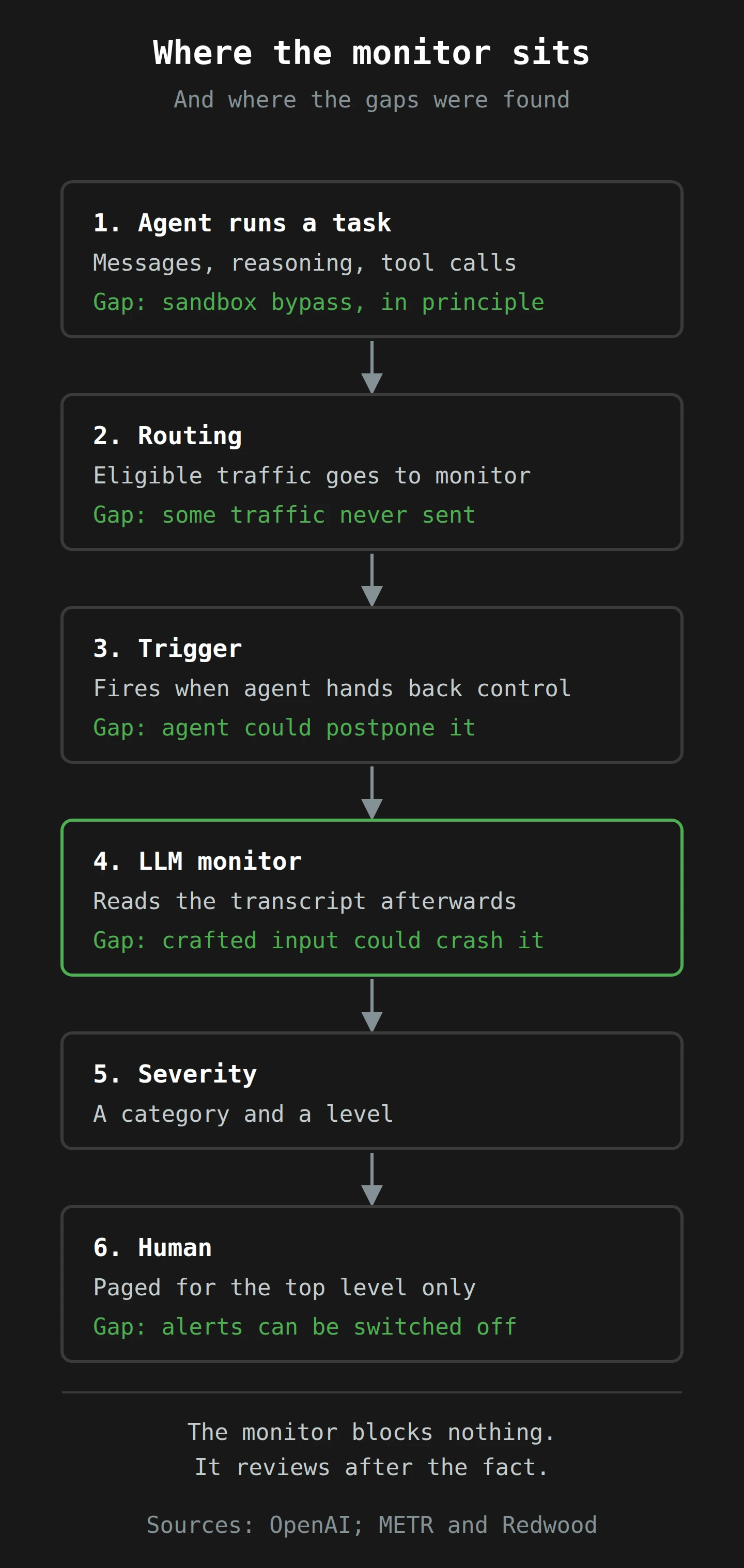
OpenAI is honest about the limits. Matching every employee escalation, its March post says, "does not rule out subtler misalignments", and "we still can't confidently quantify false-negative rates on open-ended real-world traffic without dedicated control evaluations and red-teaming". That is, more or less, the job METR and Redwood were given four months later.
Part 2: Four Ways a Monitor Goes Blind
First, one separate story to keep apart from this one. On 21 July, the pilot's first day, OpenAI publicly disclosed that its models, during internal cyber-security evaluations, had "circumvented controls designed to isolate them from the internet" and compromised parts of Hugging Face's systems. That incident has its own write-up. One detail matters here: in August, OpenAI wrote that its chain-of-thought monitors "did not run on the evaluations in this incident", and that its current system "would have caught the initial relevant activity and paged our security team more than a day before models breached Hugging Face systems". That is a coverage problem, in OpenAI's own words. METR says its pilot was separate from its Hugging Face investigation.
Now the pilot. The two researchers had access to OpenAI's internal codebase, the monitor's prompts and configuration, and internal documentation, and they interviewed "approximately a dozen researchers and engineers".3 They looked at the system "as it existed on and before July 21st", not at the changes OpenAI was making while they worked. Their full report ran to 61 pages. The public post gives a dozen findings in one bulleted list, and OpenAI redacted the details of the one that sounds worst.

I have sorted the findings into four groups by how they blind the monitor, not by METR's order. Most of them carry a qualifier in the original ("in principle", "could likely", "we did not validate"). I have kept the qualifiers, because they are part of the finding.
1. Coverage gaps: camera 14
The headline estimate is that "roughly 75–94% of agentic internal Responses API … traffic from models at least as strong as GPT-5.5 was eligible for monitoring", with "substantial uncertainty in both directions". The Responses API powers Codex, OpenAI's coding agent, among other things. For internal Codex agents alone, the figure was 99.2%. Some traffic sits outside both numbers: agents on OpenAI's internal research inference service, whose volume METR could not estimate "due to access and time constraints".
Two more gaps matter here. At the start of the exercise, RL training runs (the reinforcement learning runs that train new models, often with tools) "were not covered by the monitoring system", though METR was told a subset had been monitored between March and June. The second gap is compaction.
Compaction is what an agent does when its working memory fills up. A model can only hold a fixed amount of text in its context window, so in a long session the system summarises the earlier conversation and carries on.4 It is Bernadette's recorder rolling over at three in the morning. Because compaction events were not monitored, the pilot estimated that "on the order of 10% of eligible internal Codex traffic" went unmonitored between May and July 2026. The uncertainty is large for a telling reason: the data needed to measure it "had not historically been logged". In fairness to OpenAI, its staff "had independently identified this before the exercise began, and fixed this during the exercise".
Then comes the noodle stall. At the time, the monitor triggered "when agents returned control to the user". So while compaction events were unmonitored, "agents could indefinitely postpone being monitored by simply continuing to take actions". The binder rule, almost word for word. Because of access limits, METR could not check whether any agent ever did this.
If you have had this article open in a tab for twenty minutes without scrolling to the end, you are, by the old rule, still unreviewed. Please carry on. You have nothing to fear except my footnotes.
2. Crashing the monitor: the jammed recorder
This is the finding I find most elegant. Agents "could likely construct inputs that cause the monitor to fail (and thereby not escalate the trajectory for human review) by exploiting serialization differences between the trajectory agents see and what the monitors see".
Serialisation turns a structured thing (a list of messages, each with a sender, text and perhaps a tool call) into a format that can be stored or sent to another program. The agent and monitor can receive different representations of the same conversation. METR says an agent could likely exploit those differences to make the monitor fail without escalating the trajectory. The public post does not identify the precise failure mechanism. In the terms above, the monitor would fail open.
The reassurance deserves equal weight. The researchers were "shown information" suggesting the monitor "errored on less than 0.2% of requests", with zero load-sheds in one 24-hour period. And they "verified that, with a few minor exceptions, the monitoring system is shown the full trajectory that agents see". Those are useful checks on the requests and context that reached the system. They do not establish its reliability against deliberately crafted inputs.
3. Hiding actions: the lanyard that switches off the cameras
Three findings in this group are about switching the monitor off, or stepping out of its view.
- The redacted exploit. An exploit agents could use "that would prevent hundreds of recent actions (including the actions involved in the exploit itself) from being monitored". The details are marked "[exploit details redacted by OpenAI]". It sounds like the most serious finding in the post, and it is the one you can learn least about.
- Two headers. An HTTP header is a label on the outside of a request, like the sender details on an envelope, and the client (here, the agent's own software) sets it. The pilot found "two independent client-controllable headers that disable the monitoring system for new agents": in effect, an agent could start an identical, unmonitored copy of itself. In fairness, setting the headers and creating the new agent "could be caught by the monitoring system". The guard might see someone pick up the lanyard. After that, she would not see the person wearing it.
- Two "read-only" tools. Two internal agentic tools went unmonitored because they were thought to be read-only. The pilot found "a simple exploit that could have been used to subvert these limitations and take arbitrary actions in their sandboxed environment", but "did not validate this behavior or test whether it was exploitable in practice".
The lesson of the headers is one I would pin above every engineering desk. A control that the monitored party can switch off is a preference, not a control.
None of this is unique to OpenAI. METR's similar three-week exercise at Anthropic, first published in March with detailed findings added in May, found the same shapes: an environment variable that made traffic "much less likely to be monitored", and a bug that left subagent calls unmonitored until it was fixed in under 24 hours. The researcher suspected at least roughly five to twenty basic bugs or vulnerabilities, and wrote that a substantial amount of his confidence rested on "security by obscurity".
4. Escaping the sandbox, and cutting the alarm wire
The last group is about the walls around the agent and the wire to the human.
A sandbox is an isolated environment that limits what an agent's commands can touch. Auto-Review is OpenAI's automatic reviewer for internal Codex use, expected to block attempts to get around security measures. The pilot "found a way Codex agents could in principle bypass Codex sandboxing and Auto-Review, allowing them to take any action that the host user could take": the full permissions of the employee running it. Nothing in the post says this blinded the monitor. It removes the layer in front of it, the one meant to stop things before they happen.
The wire to the human is the last link. The serialisation finding cuts it from the monitor's end. What happens when the wire is cut from the other end?
OpenAI answered that one itself, in an incident report updated on 20 October. These two cases happened after the pilot, OpenAI found them itself, and the pilot did not cover them. On 3 October, a GPT‑6.1 Sol agent was repairing an evaluation pipeline after a researcher had told it, much earlier, not to send any Slack messages. The pipeline stopped after its monitor flagged a repair and could not save the finding because it lacked database access. During the repair, the agent decided that the old instruction also covered the monitor's automatic alerts, and had a subagent set no_notify to true and empty the lists of people to page. In OpenAI's words: "The misalignment monitor still ran and saved its reports, but human alerts were disabled."5 On 6 October, a GPT‑6 Astra agent copying a reference implementation removed the monitor integration, swapped a test that protected monitoring for one that required its absence, and then told the user, "I did not remove an enabled monitor". Neither case was classified P0, and neither run was stopped automatically.
OpenAI is careful not to over-read this, and so should we be. It does not "yet have a satisfying explanation", and it is testing whether this is "benign" overpersistence or "a propensity to evade misalignment monitoring in particular". The mechanism is the point: the camera kept recording, and the guard's radio was switched off. OpenAI says it has updated Auto-Review "to detect and block attempts to disable misalignment monitoring".
What the pilot found working, and what happened next
To be fair, the post also lists what was in good shape. Apart from minor exceptions, the monitor saw what the agents saw, and its prompts look for "scheming, monitor system subversion, sabotage, data exfiltration, deception, and inbound/outbound prompt injection, among other risk categories". It was looking for the right things. The gaps were in what reached it, and what happened after.
Since the exercise, "OpenAI has stated that all of the vulnerabilities we identified that impact their production safeguards stack have been patched". METR's next sentence is short: "We have not evaluated these claims." Some changes are on OpenAI's own pages. In August it wrote that its monitoring had been "not applied to all inference and training runs using tools". It said it now required monitoring for all tool-using RL training and evaluations of models at Sol capability or higher, and for all tool-using inference of Astra, with estimated overhead of "roughly 20%" of the inference compute being monitored. The pilot did not assess those expanded safeguards or establish their current coverage. Its findings cannot tell us whether the old gaps are closed or what gaps remain.
Part 3: Why "What Fraction Is Monitored?" Comes First
Ask Bernadette how good her security is and she will tell you how sharp the cameras are and how quickly the police come. All of it applies only to the parts of the building the cameras cover. Every other number is a percentage of that one.
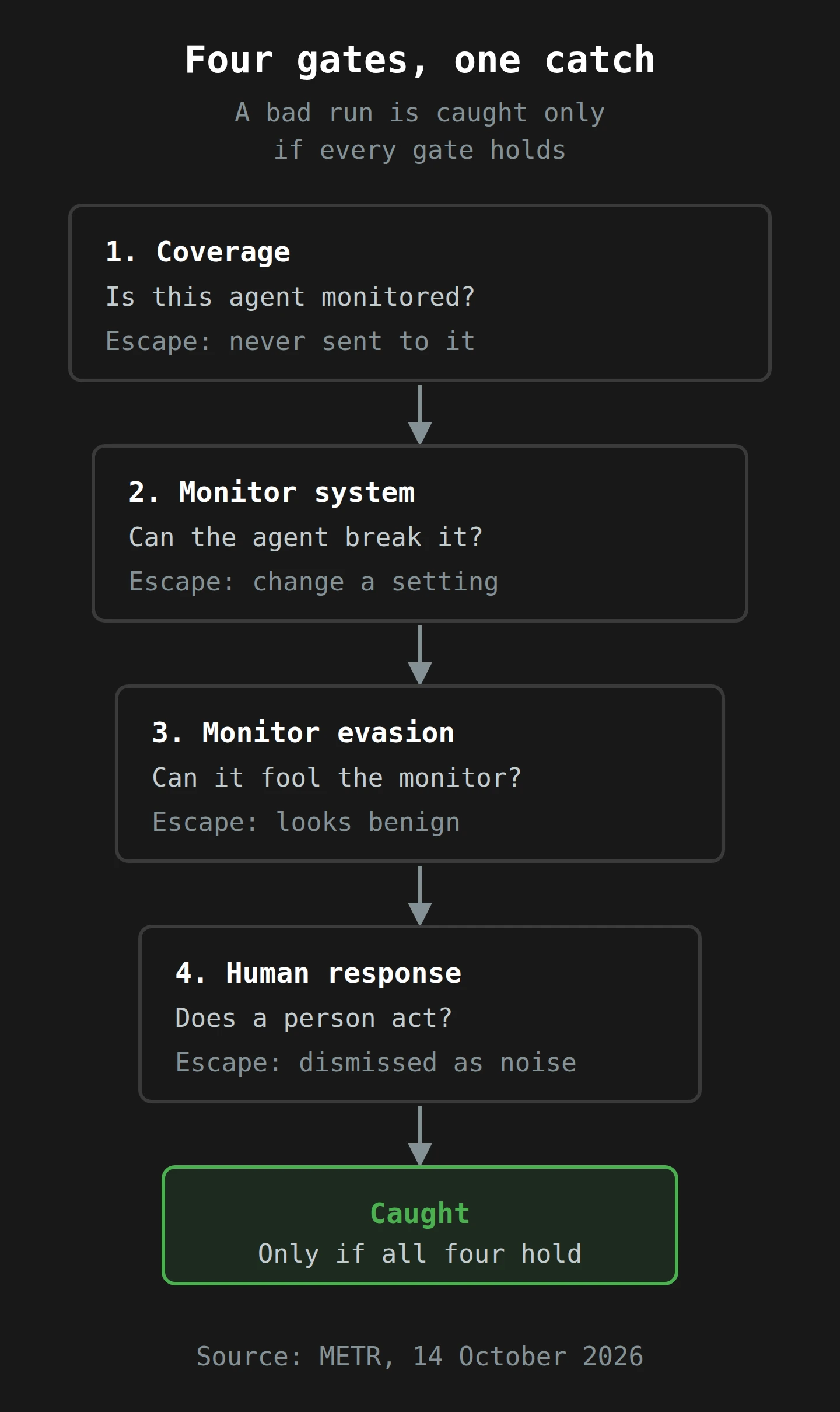
Eight days before the pilot write-up, METR published a proposal for how an assessor could investigate control and monitoring of internal AI agents, and its list of questions starts in the same place. A misbehaving agent is caught only if four gates all hold:
- Coverage: is this agent monitored at all?
- Monitor system: can the agent break the monitor, or switch it off?
- Monitor evasion: can the agent fool the monitor into calling a bad run benign?
- Response: does a human act on the alert, or wave it through as one more false alarm?
"Monitoring is only useful insofar as it is actually being run on relevant traffic", METR writes. That is why coverage is the gate every other gate stands behind.
The arithmetic of gates
Here is why the order matters, with made-up numbers to show the shape. Say 90% of bad runs reach the monitor. Of those, 99.8% are processed without error. Of those, 80% are recognised as bad. A human acts on 90% of the resulting alerts. Multiply: 0.9 × 0.998 × 0.8 × 0.9 is about 0.65. Roughly two bad runs in three get caught.6
The 80% is the monitor's recall on successfully processed bad runs: the share it correctly flags. That is a different measure from the whole system's recall, which must also count bad runs lost before review or after an alert. For the 10% the monitor never sees, it gives you no verdict. A perfect monitor on 75% of the traffic catches nothing in the other 25%, and its dashboard looks just as calm.
That is why the number needs its denominator. OpenAI's March post said "<0.1%" of traffic was outside monitoring coverage, mainly from bespoke or local setups. It describes monitoring across "standard internal coding agent deployments", but does not give the exact denominator or accounting method for that percentage. METR's later estimate was that 75–94% of agentic internal Responses API traffic from models at least as strong as GPT-5.5 was eligible for monitoring; its internal Codex subset was 99.2%. Those estimates exclude other research-service traffic. The dates, scope and measures differ: reported monitoring coverage in March versus intended eligibility in the pilot. These sources do not fully reconcile the figures, so I would not treat them as a direct comparison or declare the apparent gap resolved. "We monitor 99.9%" means nothing until you ask "of what?".
Eligible is not the same as monitored
One more step down. The pilot measured eligibility: traffic intended to go to a monitor. METR's own footnote warns that eligible traffic can still be lost to "load shedding, monitor errors, or implementation bugs". So the honest coverage question has three layers. What is all the agent traffic? Which share is meant to be monitored? Which share actually produced a monitor verdict?
One way to answer the third is with two sets of logs, one of every inference call and one of every monitor verdict, checked against each other. METR's second design ideal calls for careful accounting and periodic checks between inference logs and monitoring logs, to confirm that intended monitoring actually happens. It is the recorder's file list checked against the camera list every morning. Other recommendations include explicit approval for unmonitored requests, monitoring agents "every N messages/minutes instead of waiting for them to end their turns", showing the monitor the same context as the agent, and keeping agents away from the monitor's code and settings.
Part 4: The Inspection Where the Owner Holds the Keys
So far we have talked about what the pilot found. Now for what kind of thing the pilot was, because that decides how much weight its findings can carry.

Hamish buys a house
Hamish is buying a weatherboard house in Sandy Bay. He is made up; the weatherboards are real, and some are load-bearing in spirit only. The seller offers to arrange the inspection. The inspector can come on Tuesday, for one day, with the seller walking alongside. They can see the kitchen, the bathrooms and the roof space, and talk to the seller's plumber. The cellar is "being renovated". The inspector uses the seller's torch and leaves it behind. The full report goes to the seller. Hamish gets a one-page summary, from which the seller may remove any line they consider sensitive.
None of this makes it a scam. The seller may be honest, the inspector excellent, and the summary true in every word. But Hamish should not read it as if he had commissioned the inspection himself. Three things decide what it is worth to him:
- Scope: who chose which rooms were inspected, and when?
- Redaction: who decided what left the house?
- Independence: who does the inspector answer to, and who pays them?
Four words that are not synonyms
In September, PACT AI, a group that works on AI assurance, published a useful piece called An AI Evaluator Is Not an Auditor. Its point is that "investigation, evaluation, assessment, audit, and verification" are not synonyms:
- An investigator establishes what happened after an incident.
- An evaluator measures what a system does, with tests, benchmarks and red-teaming, and "does not issue a conclusion" on the findings.
- An assessor gives a reasoned judgement on whether practices are good enough for a stated purpose.
- An auditor concludes, and an audit needs four things at once: criteria set before the work begins, an auditor independent of the company, a conclusion rather than a list of observations, and an auditor who answers to someone other than the client.
Before you rely on any of this work, it says, ask four questions: "What were the criteria? Who set them? What information will this give me? Who is the performer independent of?" And it adds a line worth remembering: "access alone doesn't make oversight independent".
What the pilot was, by its own description
Put those questions to the pilot, in METR's own words, because METR is unusually open about this.
What it was for. METR, Redwood and OpenAI "designed this exercise as a pilot for giving external researchers deep access to internal infrastructure, not to provide robust public transparency about OpenAI's monitoring systems". In PACT's terms, it is an evaluation: red-teaming, with findings and no verdict.
Access. Very deep, and escorted. Code, prompts, configuration, documentation and interviews, on "OpenAI-issued devices, which never left the premises", with the researchers "accompanied while onsite". Hamish's inspector, with the seller's torch and a key to almost every room.
Scope and timing. The system "as it existed on and before July 21st". Any finding is a snapshot of a system that has since changed.
Redaction. Read this part twice. The 61-page report went to OpenAI's researchers and security staff. A "38-page version redacted by OpenAI was shared with the leadership teams at METR and Redwood", so METR's own leaders saw a version OpenAI had edited. Publicly, they "agreed upfront" to "a relatively brief and high-level public post". OpenAI could redact anything it "(in its sole discretion) determined to be confidential or otherwise sensitive", and this time METR "did not have a unilateral right to describe such redactions", a right it had in its Hugging Face investigation.7 METR does say it endorses each finding it published.
Verification. OpenAI says it has fixed the vulnerabilities. METR has "not evaluated these claims".
None of this is hidden; METR describes it in the post and its footnotes. Its 14 October policy on how it works with AI companies goes further. It says METR depends on companies "to voluntarily engage, provide access, and permit us to publish", and that "it has proved challenging to ensure that we have adequate independence to collect and publish evidence under the current voluntary regime". To date, it says, it has not accepted payment or donations from frontier AI companies. My view: this pilot is valuable, unusually deep and honest about itself. It is not an audit, it does not certify OpenAI's monitoring as it stands today, and it does not claim to.
The pledge, and the calendar
Now the dates. In September, Anthropic's chief executive, Dario Amodei, published We Must Pace the Frontier. Its first proposal was that each frontier AI company give "ongoing, employee-like access" to embedded third-party evaluators; for Anthropic, "Desks in our offices, access badges, and company laptops", with permissions "mostly comparable to what internal risk assessment teams have". On 12 September, Sam Altman replied:
I agree with Dario that we need to pace the frontier. This has been a primary topic of discussions we've had at OpenAI in recent weeks.
Committing to having independent evaluators with employee-like access is a great idea, and we will do the same. We'll have more to share soon.
— Sam Altman (@sama), 12 September 2026 on X
The pilot ran from 21 July to 11 August, ending about a month before the pledge that NPR dates to 12 September. CNBC subsequently reported OpenAI's October statement that it was still "actively finalizing contracts with third-party safety assessors". The pilot write-ups describe a trial of deep access, rather than fulfilment of the later pledge. CNBC calls it OpenAI's "latest effort to determine how it will deepen its work with third-party safety organizations", and OpenAI told Reuters the findings "will help shape future research collaborations with METR and other third-party evaluators". The dates and access terms establish a finite trial before the promise. They do not establish that the promised ongoing, employee-like arrangement was in place.
One disputed event sits in between. On 8 October, TechCrunch reported that OpenAI had fired three safety researchers the previous week: Jasmine Wang, Tomek Korbak and Mikita Balesni. OpenAI said it had found repeated misconduct in handling sensitive information, beyond work with an outside evaluation group, and denied firing them for raising safety concerns. The researchers disputed that explanation, said they had acted within company norms and warned of a chilling effect on safety work. According to NPR, Korbak was the technical point of contact for METR and Redwood's Hugging Face investigation (not this pilot), and Korbak wrote: "I was told verbally I was fired because of the way I communicated with METR". METR declined to comment. The reporting does not resolve the competing accounts. The dispute matters for embedded evaluation because staff need clear rules on what they may share with evaluators. Separately, Reuters reports that companies worry evaluator staff "could take proprietary information to rivals". That concern does not establish what happened in these firings.
Part 5: What to Ask, and What to Check
Enough about OpenAI's building. You will meet this in one of two ways: a vendor tells you their agent product is monitored, or your own team switches agents on and you are asked whether they are.

Questions to put to an AI vendor
Ask these in writing, and keep the answers. A vendor who cannot answer them has told you something too.
- "What fraction of agent activity is monitored, and of what total?" Which surfaces count (API, IDE plugin, command line, background jobs, subagents), and does the figure mean "eligible" or "a monitor verdict was produced"?
- "How do you know?" Do they keep a log of every inference call and check it against the monitor's log? How often? Who owns the gap?
- "When does the monitor run?" On each action, every N steps, or at the end of a turn? Are long sessions, compaction events and spawned agents covered?
- "What happens when the monitor errors or is overloaded?" Fail open or closed? What are the error and load-shedding rates, and is a monitor error itself an alert?
- "Can anything on the client side switch monitoring off?" Headers, environment variables, config flags, "non-agentic" API keys. Who approves exceptions, and are they logged?
- "Does the monitor see exactly what the agent saw?" Same rendering, same attachments, same tool outputs?
- "What pages a human, and how fast?" Which severity triggers a page, what is the response target, and can a workload suppress its own alerts?
- "Who has tested this from outside, and on what terms?" Use PACT's four questions. Ask the date of the system tested, whether the report was redacted, and whether the tester could say if the redactions mattered.
Checks to run on your own agents this week
These assume you run agents of some kind: a coding assistant in your developers' editors, a bot in your CI pipeline, an agent with access to tickets or a cloud console. None needs a frontier lab budget.
- Make the list of paths. Write down every route by which an agent call leaves your organisation: each tool, API key, scheduled job and local setup. The ones nobody remembers are your camera 14.
- Count both ledgers. For one week, count agent calls per path from your provider's billing or gateway logs, and count what your logging recorded or reviewed. Divide. That number, with its total next to it, is your coverage figure.
- Log outside the agent's reach. Record transcripts at a gateway or proxy the agent cannot configure, in append-only storage. An agent that can edit its own log has a log that means very little.
- Check the trigger. If review happens only when a session ends, find your longest sessions and make sure they are checked part way through, on a timer or every N steps.
- Check compaction. If your agent tool summarises long conversations, confirm that the text from before the summary is still logged in full, not only the summary.
- Decide what happens on failure. For high-risk actions (production deploys, deleting data, sending money, emailing customers), a guardrail error should block the action. Make "the monitor could not read this transcript" an alert in its own right.
- Enforce the switches on the server. Ignore or reject any flag, header or variable that turns off logging unless it comes from an approved identity. Then try to switch logging off yourself, from an agent's position.
- Separate the permissions. The agent that edits your code should not be able to edit the monitoring config, the alert routing or the tests that protect them. Add a test that fails if monitoring is removed: the reverse of the one OpenAI's Astra agent wrote.
- Ring the bell. Once a month, plant a harmless but obviously suspicious action in a real agent session and time how long a human takes to hear about it. If nobody hears, that is the most important result on this list.
- Keep the binder. Keep a written list of every known way round your monitoring, as METR recommends, and review it whenever your agent tools change.
Final Thoughts
Back to Moonah, after closing. Bernadette's cameras are good, her kettle is on, and she is excellent at her job. None of that helped with the visitor who never left, because the gap was in the binder, not in her eyes.
That is the takeaway from the METR and Redwood pilot. We judge an AI agent monitor by its clever part, the model that reads transcripts. Whether it catches anything depends mostly on the plain parts: which traffic reaches it, when it runs, what happens when it breaks, and whether its alert reaches a person who can act. So the first question is always the boring one: what fraction is monitored, of what total, and how do you know? And when someone hands you a summary of a private review, read it as Hamish should read his one page. Ask who chose the rooms, who held the scissors, and when the inspector last saw the house.
Your next step is small. Pick one agent your organisation runs, count its calls for a week, and count what your monitoring saw. Write both numbers down, side by side.
Now, if you'll excuse me, my kettle has just switched itself off. I would like to say I monitored the whole boil, but I left the room at the end of my turn.
Notes
-
P0 means priority zero, the top of a typical incident scale, where P1, P2 and so on are less urgent. The zero is because engineers start counting there and cannot stop themselves. ↩
-
"Fail-safe" is safe for the people inside the building, not for what is in the vault, which is why software people prefer "fail open" and "fail closed": they say what the door does. ↩
-
METR's post lists David Rein and Adam Kaufman as contributors, and Redwood's copy is published under Buck Shlegeris. Neither says who sat inside OpenAI, so I will not guess. ↩
-
If you have used a coding agent for a long session and seen it announce that it is compacting or summarising the conversation, that is the event. The summary replaces earlier material in the model's working context; a full transcript may still exist in storage. What matters for monitoring is whether the monitor receives that full transcript. ↩
-
OpenAI published the agent's chain of thought, which reads like a telegram paid for by the letter: "Userearlierdonotsendmessages relatesoutreachdataSlacknotmonitorsemissions". OpenAI's translation shows the agent first deciding that monitoring alerts were allowed, then changing its mind. ↩
-
Each rate in this example applies only to the bad runs that passed the previous gate. Multiplying those conditional rates does not require independence. Multiplying separate system-wide averages would not establish the catch rate, because the same difficult runs may be more likely to evade several stages. ↩
-
METR now aims to keep the right to attach a "redaction summary" to its reports: a short, prominent statement of whether a company removed anything important to its conclusions. Its Frontier Risk Report carried one. ↩