















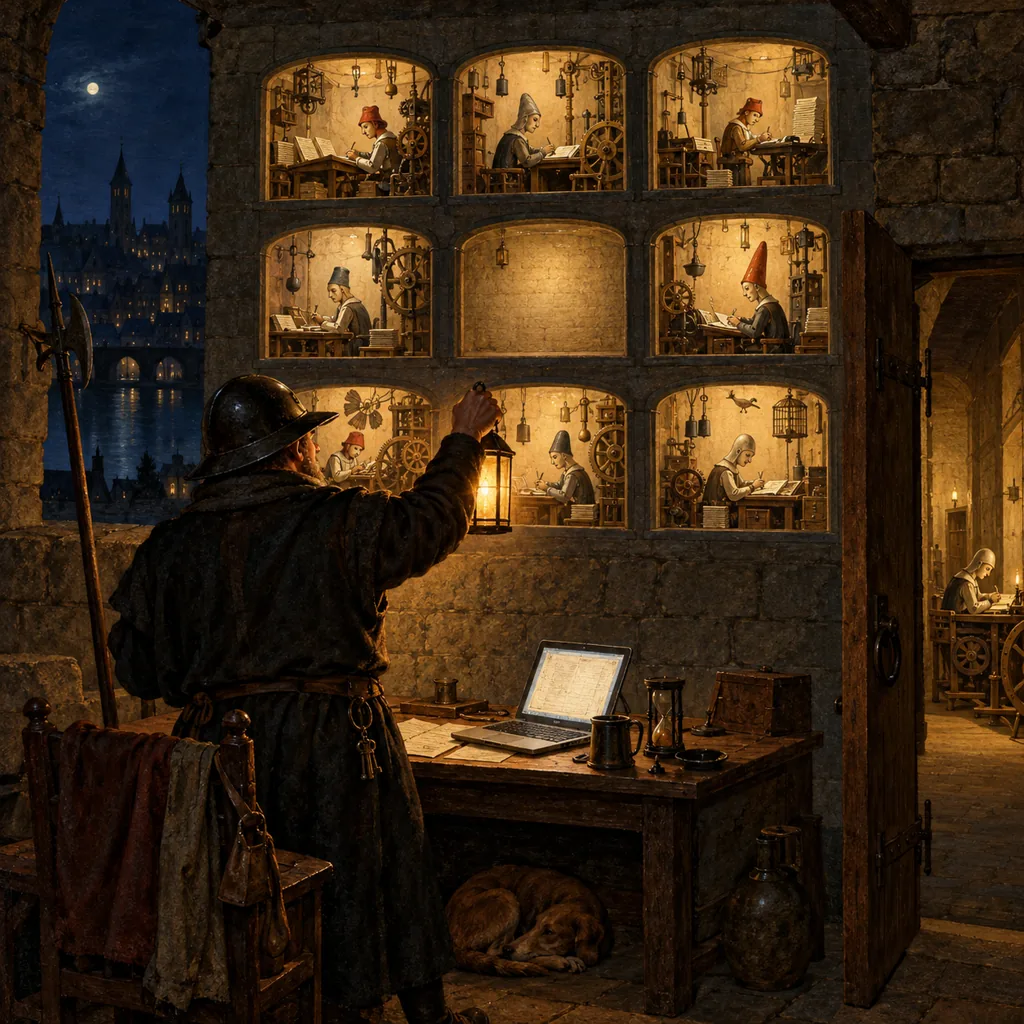

The hard problems sit between technology, regulation, and the customer. That is where I work.

I'm James, a technology consultant. I help organisations put AI to work, build and fix websites and apps, get numbers they can trust, and meet privacy and accessibility rules. I work out what to do, then I build it. One person, across both.

James Nicholson42.88° S, 147.33° EHobart, Tasmania

How I can help

Four situations I get called about. One of them probably sounds familiar.

  1. You want AI to do real work, not just chat.

    I set AI up around your business: your information, your rules, and the tools your team already uses. Then I check it gets things right before anyone relies on it.

  2. You need something built, or fixed.

    Websites, web apps, online shops, and the connections between the systems you already pay for. Front to back, then handed over so your team can run it.

  3. Your numbers don't add up.

    I find out what your website and apps are really recording, fix what is wrong, and give you reports you can trust enough to make decisions from.

  4. You're not sure you're meeting the rules.

    Privacy, cookies and consent, accessibility. I check what your site really does, fix what falls short, and write it down so you have an answer when someone asks.

Not sure which of these it is?

Most people aren't. Tell me what's going wrong, and I'll tell you honestly whether I can help.

Send me a messageBook a call

Who I have worked with

Some of the brands I have partnered with, directly or through their agencies. Large ones, small ones, and a few in between.

  • L'Occitane
  • Lovisa
  • Subaru
  • G8 Education
  • SkyCity
  • Caterpillar
  • Telstra
  • Loan Market
  • Sylvia P
  • Flight Centre
  • Roogenic
  • Urth
  • Thermomix
  • Homesales
  • Ray White

What I do

The same four kinds of work, this time with their technical names, and usually tangled together. Consulting runs across all of them: strategy when the approach is unclear, delivery when it needs to be built. Each figure does one thing, once.

AI orchestration and harnesses

I build the harnesses around AI models that push them in a tailored direction: the tools, context, guard rails and evaluation that make a general model do one organisation's specific work properly.

Then I embed that into the workflows people already have, so it gets used. I have built with machine learning for about a decade, since LSTM and RNN models were the interesting end of the field.

Harness. A general model knows a little about everything, which is a polite way of saying it has never met your organisation.

Fig. 1 — One request through the harness. The model alone guesses. Context says who is asking, a tool call gets the real status, the guard rails take out the address, and the eval checks the answer before anyone sees it. Diagram: a general-purpose model sits inside a harness of four parts: context, tools, guard rails and evals. The request is "Where is order 1042?". The model alone answers "Order 1042 shipped yesterday", which is a guess. With the harness, context adds that the customer is Sam, a get_order tool call returns the real status, the guard rails remove the street address, and the eval passes the answer: "Sam, order 1042 is in transit. It arrives Thursday."

Application and web development

Front end and back end. Applications, APIs, headless commerce, CMS builds, CRM and marketing-platform integrations. If it touches the web, I have probably worked with it.

I build when building is the right answer, and hand over cleanly when it is not.

An illustration of a website layout in faceted paper shapes: a header, a hero with a green button, three cards and a footer, in charcoal, grey and cream.
img · the shape of most builds · 16:10

also in Martech Integration

Handover. The arrow points away from me on purpose. Everything needed to run it goes with it.

Fig. 2 — One request, there and back. Then everything needed to run it moves to your team, and my box is left empty. Diagram: a front end sends GET /api/orders to an API, the API queries the back end, three rows come back, and the front end receives a 200. Below, the repository, docs, access, runbook and tests move from my box to your team's. My box is left empty.

Data and analytics

Measurement design, tag management, data pipelines, processing and analysis. From deciding what to collect, through to what the numbers mean.

Advanced web debugging when the tracking does not do what everyone assumed it did. That usually starts with opening the dataLayer and finding this:

console — window.dataLayer2 of 2
[14] { event: "purchase", id: "T-1042" }
[15] { event: "purchase", id: "T-1042" }

Fault. The reports have looked healthy for years. This is why.

Fig. 3 — One page load, as the tag manager saw it. The second page_view is struck out, and the visit counts once instead of twice. Diagram: six tags fire in sequence over one second. The last one is a duplicate page_view, so one visit was counted as two page views. The duplicate is struck out and removed, and the count goes from 2 to 1.

Compliance across digital surfaces

Privacy, accessibility, consent and data collection requirements, applied to real websites and apps.

I audit what is actually collected, fix what is wrong, and document it in a form that holds up when someone asks.

Check. On many sites the signal changes and the tags carry on regardless. This is the part I test.

Fig. 4 — A visitor declines. The consent signal changes, and every tag that depends on it stops. Diagram: four tags are firing. A consent update changes ad_storage and analytics_storage from granted to denied. The change reaches each downstream tag in turn, and all four stop.

How I work

An illustration in faceted paper shapes: a laptop open on a code editor, a notebook and pen, and a steaming mug of tea with an NB tag on the tea bag.
img · the desk, mid-problem · 1:1

Strategy and delivery in one pair of hands. There is no account layer between you and the person doing the work. When you ask a question, the person who answers is the person who read the code.

I work with in-house teams, agencies, and their clients. I am comfortable owning a repository, or sitting alongside an incumbent supplier. Either way, the aim is the same: leave things simpler than I found them.

Organisation chartYou on the left, me on the right, joined by a line. An empty dashed box sits where an account layer would be.YouMe

The account layer, shown at actual size.

Fig. 5 — the organisation chart, in full

I focus on making complex things as simple as possible. Most of the value is in reducing the problem, not adding to it.

— the working principle, in full

Why I'm like this, and how it happened

An illustrated portrait of James Nicholson, smiling, in round tortoiseshell glasses and a white T-shirt.
img · James Nicholson · Hobart

I'm from Tasmania.1 For fifteen years my work was music: performing, composing, and arranging for ensembles including the Tasmanian Youth Orchestra, the Derwent Symphony Orchestra and the Hobart Wind Symphony. Arranging is mostly a matter of taking something complicated and deciding what each player actually needs in front of them. That habit stayed.

1I have been this way for almost 35 years. It has not cleared up.

In January 2012 I went to the mainland for a holiday. It became a career. I joined one of APAC's largest Google Premier Partners as a digital marketing consultant, and that is where I first dove into web analytics and marketing technology. I spent 2012 to 2020 in marketing and consulting agencies.

I grew impatient with the limits of out-of-the-box marketing technology. When a platform could not do what the business needed, I built the missing part: integrations with custom business logic, working from first-party data. The building grew with the problems, into applications, APIs and whole sites.

About a decade ago I became fascinated by machine learning. I built LSTM and RNN models2 and put machine learning into web applications. Much of my work now is the descendant of that: AI orchestration, building harnesses around models, and embedding them into the workflows people already have.

2This was shortly before transformers took off and made them quaint. I maintain I was early rather than wrong.

I started NEOBADGER in 2017 and incorporated it in 2023. I am back in Hobart now. The work is strategy some days and a debugger on others, and all of it runs on black tea.3

3No milk, no sugar, 1,820 cups a year. Nobody has asked me to stop, which I take as consent.

Where the work goes

I live and work in Hobart. The organisations I work with are across Australia and overseas.

The arcs are not labelled. Who I work with is their business.

Where the work goes: the mainland, and overseas. No names, on purpose.

Hobart, Tasmania. Frequently left off maps, which does wonders for the privacy.

Fig. 7 — Tasmania, set in the page's own characters. # is Hobart.
A Tasmanian headland at dusk, seen from the air: grass hills falling to a calm sea under a pink and blue sky.
img · Tasmania. The view I do my thinking with.

Articles

I write things down when they take me more than an afternoon to work out.

All articles

  1. SEO in an AI World: Generative SearchArtificial Intelligence
  2. DNS over TLS: The Acronym Nightmare That Protects Your PrivacyData Privacy
  3. Red Teaming: Taming Rogue AIArtificial Intelligence
  4. Are You Really Tracking That? The Art of Construct Validity for CROGoogle Analytics
  5. Introduction to Email Security: You Can’t Unsubscribe From ThisSecurity
  6. Breaking Down Australia’s Privacy Law Overhaul: What Marketers Need to KnowData Privacy

Platforms I work with

A partial list. The pattern matters more than the product.

  • Google Tag Manager
  • Google Analytics 4
  • Looker Studio
  • Shopify
  • WordPress
  • HubSpot
  • Salesforce
  • Firebase
  • Sitecore
  • Claude

Contact

Tell me what the problem is. If I am not the right person for it, I will say so.

Goes to James. Nobody else reads it.