LinkedIn Trained on Your Posts: The Opt-Out Nobody Saw
It is a Wednesday in September, and you have just written the best LinkedIn post of your life. Seven hundred words on what a hard project taught you. You took the client's name out. You took the budget out. You kept the bit about the workshop where the projector caught fire, because it is true and because it shows growth. You read it twice, add a photo of a whiteboard (cropped, carefully), press Post and go to put the kettle on.
While the kettle boils, the post goes to work. Forty-one people like it. A recruiter in Sydney calls it "inspiring". And somewhere in your account settings, on a page you have never opened, there is a switch labelled "Use my data for training content creation AI models". It says On. You did not turn it on. Nobody asked you. As far as you knew, the page did not exist when you went to bed.
Follow that switch to its logical end and things get strange quickly. Your sentences, your rhythm, your well-judged "and that's when I realised" become a tiny part of the material a machine uses to learn how professionals write. A year from now, someone in Ohio asks a writing assistant to help with a post about their promotion, and a faint, statistically averaged echo of your projector fire helps them say "humbled". In a very small way, you have become the house style of the world's largest professional network. Unpaid. Uncredited. With your tea going cold.
Sit down. Finish the tea. Nobody has stolen your voice, and the machine is unlikely to quote your post back to anyone word for word. (Unlikely is doing some work in that sentence. We will come back to it in Part 4.) But the switch is real. On 18 September 2024, LinkedIn members outside the EEA and Switzerland noticed a setting called "Data for Generative AI Improvement", and, going by the screenshots they shared, found it already switched on. 404 Media reported that LinkedIn was using member data to improve its generative AI before it had updated its terms of service, and that LinkedIn said the update would come "shortly". It came later that day, and the new privacy policy took effect the day it was published. Members in the European Economic Area and Switzerland never saw the setting at all, because LinkedIn was not training on their data. Two days later, after the UK's Information Commissioner's Office raised concerns, the UK joined them.
LinkedIn says it has more than 1 billion members in more than 200 countries and territories. Most of them are outside those regions. Australia is outside those regions. So, as of this week, a great many people, very likely including you and the people you work with, sit in the group where the answer was yes until they said no.
That is the story in one line: the same company, on the same day, offered two different deals, and the difference was the law. So I will walk through what changed and in what order, why Europe got a different button and what the law there actually asks for, why a default makes nearly all the decisions, and why "does not affect training that has already taken place" is the most honest and most important sentence in the whole affair. Then a (made-up) consultant in Burnie posts a case study, and we watch what each system records.
Let's get into it.
Part 1: What Happened, in Order
Most privacy stories are about what a company does with your data. This one is mostly about when it told you.
The setting arrived before the paperwork
The earliest public sign I can find is a post by the security researcher Kevin Beaumont, on Mastodon at 05:57 UTC on 18 September, which was 3:57 pm in Hobart.1 He posted a screenshot of a new screen in the LinkedIn app. It asks, "Can LinkedIn and its affiliates use your personal data and content you create on LinkedIn to train generative AI models that create content?" Below that sits a switch, "Use my data for training content creation AI models", set to On. Beaumont's summary was blunt: "the setting is enabled by default."
Then the press caught up. Joseph Cox at 404 Media asked LinkedIn what was going on, and posted the answer:
New from 404 Media: LinkedIn is training AI on users before updating its terms of service. People noticed a new setting on generative AI. I asked LinkedIn, they said they're updating their terms "shortly." They went ahead and trained AI w/o updating
— Joseph Cox (@josephfcox), 18 September 2024 on X
404 Media called the move "unusual", because terms of service are "one of the main documents that can explain how users' data is collected or used". The paperwork is meant to arrive first.
LinkedIn's help centre was a step ahead of its legal documents. By the morning of 18 September (UTC), the generative AI FAQ already told members how to opt out, using the "Data for Generative AI Improvement member setting". It said the setting was available "initially" to members "whose profile location is outside of the EU, EEA, or Switzerland", and it named the data in play: "your posts and articles", among other things.2
Later that day, LinkedIn's general counsel, Blake Lawit, published Updates to LinkedIn's Terms of Service. The key paragraph:
In our Privacy Policy, we have added language to clarify how we use the information you share with us to develop the products and services of LinkedIn and its affiliates, including by training AI models used for content generation ("generative AI") and through security and safety measures.
And then:
When it comes to using members' data for generative AI training, we offer an opt-out setting. At this time, we are not enabling training for generative AI on member data from the European Economic Area or Switzerland, and will not provide the setting to members in those regions until further notice.
Notice the word "clarify". LinkedIn's position is that this was a clearer description of something it already did, not a new practice. In fairness, there is some support for that. Back in May, the same FAQ page already said, "Where LinkedIn trains generative AI models, we seek to minimize personal data in the data sets used to train the models". So training was mentioned, in a help article. What was new in September was the setting, its default and the wording in the privacy policy itself.
Two documents, two effective dates
Here is the old privacy policy, effective 31 July 2024, on how LinkedIn uses your data:
We use the data that we have about you to provide and personalize our Services, including with the help of automated systems and inferences we make, so that our Services (including ads) can be more relevant and useful to you and others.
And the new one, effective 18 September 2024:
We may use your personal data to improve, develop, and provide products and Services, develop and train artificial intelligence (AI) models, develop, provide, and personalize our Services, and gain insights with the help of AI, automated systems, and inferences, so that our Services can be more relevant and useful to you and others.
"Develop and train artificial intelligence (AI) models" is the change that matters. It took effect on the day it appeared.
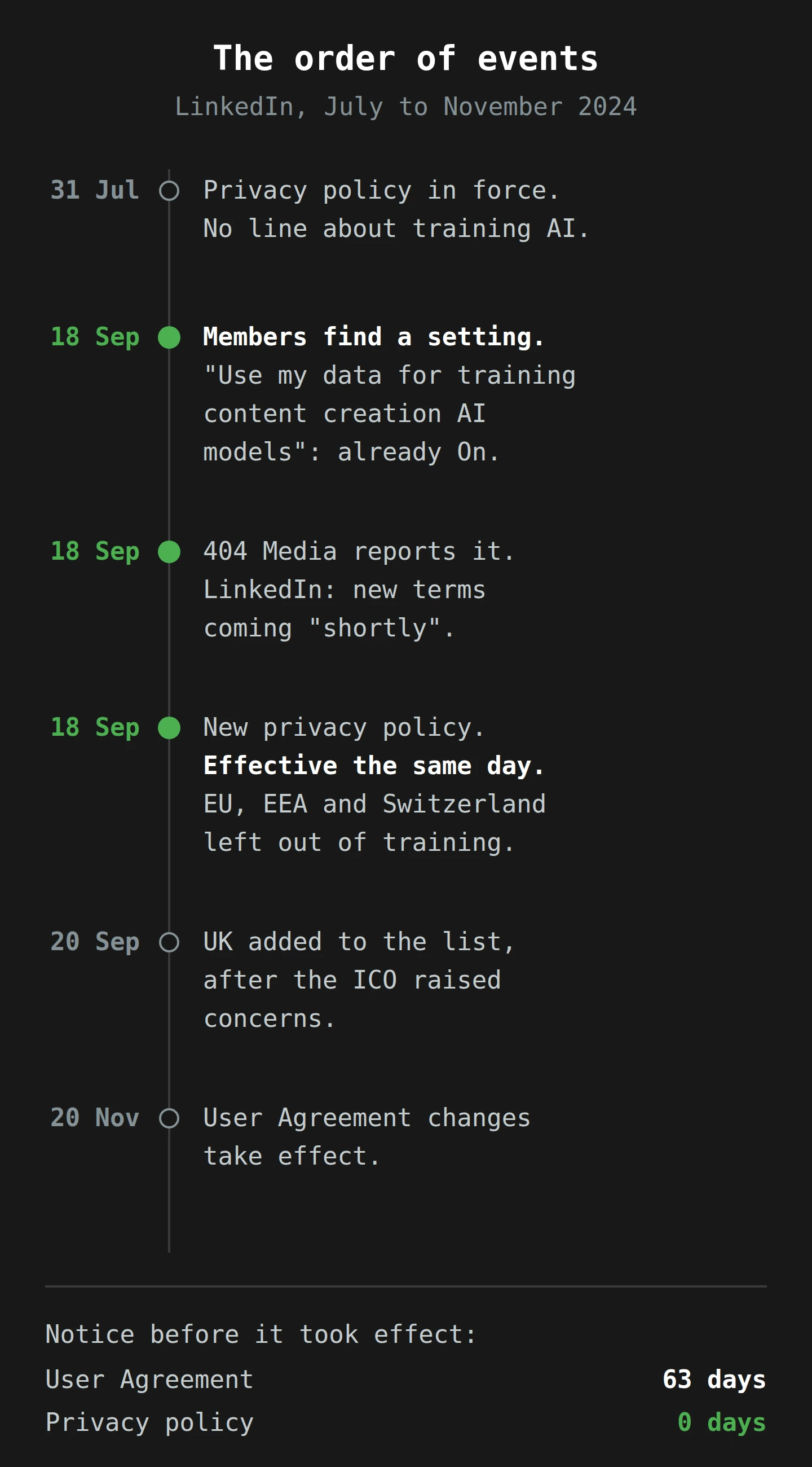
Now the part I keep coming back to. Lawit's post says the User Agreement changes "will go into effect on November 20, 2024". So the contract got about two months' notice. And both versions of the privacy policy contain the same promise: "if we make material changes to it, we will provide notice through our Services, or by other means, to provide you the opportunity to review the changes before they become effective."
Put the two dates side by side. The User Agreement got 63 days between notice and effect. The privacy policy, which is the document that covers training AI on your posts, got none. I am not your lawyer, and LinkedIn would say this was a clarification rather than a material change. But on the face of the documents, the one about the contract had a waiting period and the one about your data did not.
Then the UK
The reaction outside the US was quick, and it focused on the map. Wolfie Christl put it like this:
So, LinkedIn joined other predatory platform intermediaries in grabbing everyone's user-generated content for generative AI training by default—except in GDPR land.
Seems like the GDPR and European data protection regulators are really the only effective antidote here globally.
— Wolfie Christl (@WolfieChristl), 18 September 2024 on X
The same day, the UK digital rights group Open Rights Group called on the ICO to act. Its legal and policy officer, Mariano delli Santi, said, "LinkedIn is the latest social media company found to be processing our data without asking for consent."
Some time between the evening of 19 September and the early afternoon of 20 September (UTC), Lawit's post changed. The excluded regions became "the European Economic Area, Switzerland, and the United Kingdom", with a note at the bottom: "We've edited this post to provide additional information."3 On 20 September, the ICO's Stephen Almond said:
We are pleased that LinkedIn has reflected on the concerns we raised about its approach to training generative AI models with information relating to its UK users. We welcome LinkedIn's confirmation that it has suspended such model training pending further engagement with the ICO.
He added that "it is crucial that the public can trust that their privacy rights will be respected from the outset." LinkedIn's statement to TechCrunch was short: "We welcome the opportunity to continue our constructive engagement with the ICO."
"From the outset" is the phrase to hold on to. It is the thing that did not happen.
What the switch covers, and what it does not
Before we get to why, it is worth knowing exactly what the switch does, because it is narrower than most people assume. LinkedIn's help page for the setting says it controls whether your data "(such as profile data or content in posts)" may be used to train or fine-tune generative AI models that create content. Then come the limits:
- It does not cover AI models "used to personalize your LinkedIn experience or models used for security, trust, or anti-abuse purposes".
- It "does not control the use of your data during the use of a generative AI feature". If you paste text into LinkedIn's writing assistant, that text is still processed as an input, whatever the switch says.
- For AI models that do not generate content, the FAQ points to a separate "LinkedIn Data Processing Objection Form".
- The switch speaks for "LinkedIn and its affiliates". LinkedIn's privacy policy names its affiliates as "including Microsoft", and the FAQ says some of its models are provided by "Microsoft's Azure OpenAI service".
And the sentence I promised you in the intro, also from the FAQ: opting out means LinkedIn and its affiliates "won't use your personal data or content on LinkedIn to train models going forward, but does not affect training that has already taken place."
Keep that one in your pocket. It comes back in Part 4.
Part 2: Why Europe Got a Different Button

The same company, running the same platform, on the same day, gave a member in Dublin one deal and a member in Devonport another. That is not an accident of engineering. It is a map of privacy law, drawn in a settings page. To read the map, start somewhere much smaller.
The plumber test
You give your mobile number to a plumber so he can text you when he is on his way. A week later you start getting messages about his cousin's kayak tours on the Huon. Nobody wrote down a rule that said "don't do that", and you are still annoyed, because you know the deal you made. You handed over your number for one job. Using it for a different job breaks an expectation that both of you understood without saying it.
You use this test all the time. You probably have never named it.
Purpose, and the six doors
Privacy law names it purpose. Information collected for one purpose comes with limits on what else it can be used for. In Australia, Australian Privacy Principle 6 says an organisation can use personal information for the purpose it was collected for, and for a secondary purpose only if an exception applies. The main exception is the plumber test, written by lawyers: the person "would reasonably expect" the secondary use, and the secondary purpose is related to the first (for non-sensitive information, there must be "more than a tenuous link"). The OAIC's guidelines say the test is what a reasonable person, "who is properly informed", would expect. I have written about where Australia's Privacy Act review wanted to take this if you want the longer history.
Europe and the UK take a stricter route. Under the GDPR (and the UK's own version of it), every use of personal data needs a lawful basis, and Article 6 lists six of them. Think of them as six doors into a building. You must walk through one of them, and you must be able to say which. Two of the doors matter here:
- Consent: the person "has given consent to the processing of his or her personal data for one or more specific purposes". They said yes, specifically, in advance. This is the opt-in door.
- Legitimate interests: the processing "is necessary for the purposes of the legitimate interests pursued by the controller", unless the person's own interests or rights override them. Here the company does not ask for permission. It does a test, and if it passes, it can go ahead.
The UK regulator spells out that test in its guidance on legitimate interests as three parts:
- Purpose test: is there a legitimate interest behind the processing?
- Necessity test: is the processing actually necessary for that purpose, or is there a less intrusive way?
- Balancing test: do the person's interests, rights or freedoms override that interest?
The ICO describes the balancing test as "a light-touch risk assessment", and it is where the plumber comes back. The guidance says the person's interests "could in particular override your legitimate interests if you intend to process personal data in ways the individual does not reasonably expect." Same test, different building.
Where an opt-out fits
Now we can see why the button looks the way it does. When a company relies on legitimate interests, the person gets a right to object. Article 21 says the person can object "at any time", and then the company must stop unless it shows "compelling legitimate grounds" that override theirs. The same article says the company must tell people about that right, at the latest at its first communication with them, and that the notice "shall be presented clearly and separately from any other information".
So an opt-out is the natural shape of a legitimate interests process: you tell people clearly, give them a simple way to say no, and respect it. That is lawful in principle, if the three-part test holds up. Whether it holds up for AI training is the live argument of 2024. Open Rights Group says no: "Opt-in consent isn't only legally mandated, but a common-sense requirement." The ICO has not gone that far. In its call for evidence on generative AI, it said that "five of the six lawful bases are unlikely to be available" for training on data scraped from the web, which leaves legitimate interests as the realistic door. That consultation is about scraped data, not data a platform already holds, but the test is the same. It also called web scraping "invisible processing", where people do not know their data is being used.
The ICO's clearest line on the question came five days before LinkedIn's setting appeared. When Meta decided to resume its plans to train generative AI on UK users' Facebook and Instagram data, the ICO said on 13 September:
Organisations should put effective safeguards in place before they start using personal data for model training, including providing a clear and simple route for users to object to the processing.
It also said, pointedly, "The ICO has not provided regulatory approval for the processing".
Now hold that next to the timeline. LinkedIn's route to object existed, but members found it on their own, and the setting came before the privacy policy described the use. An opt-out people discover from a security researcher's screenshot is a long way from "clearly and separately", and a close cousin of invisible processing. That is my view, not a regulator's finding, but it fits with the ICO raising concerns within two days.
The European regulators had been busy
LinkedIn did not make this choice in a vacuum. By September 2024, the regulators in Europe had made their position on default AI training very visible.
In June, Meta paused its plans to train generative AI on UK users' Facebook and Instagram data, in the ICO's words, "in response to a request from the ICO". In August, Ireland's Data Protection Commission went to the High Court over X's AI model, Grok, and X agreed to suspend its processing of the public posts of EU and EEA users that it had processed between 7 May and 1 August 2024. It was the first time the DPC had used that power, under Section 134 of Ireland's Data Protection Act 2018.
Ireland's DPC said LinkedIn had told it about the change, and it told TechCrunch that LinkedIn's opt-out "is not available to EU/EEA members as LinkedIn is not currently using EU/EEA member data to train or fine-tune these models." Given what had happened to X a month earlier, it is not hard to see why LinkedIn left Europe out. When the UK regulator raised its hand, the UK went into the same box within two days.

And here in Australia
Australia does not have the six doors. There is no general requirement for a lawful basis, and no general right to object like Article 21. What we have is APP 6 and its reasonable expectation test, which is real but asks less of a company up front.
The week before LinkedIn's setting appeared, we got a vivid example of what that means. At a Senate inquiry hearing in Canberra, reported by the ABC on 11 September, Greens senator David Shoebridge put it to Meta's Melinda Claybaugh that unless Australians had set their posts to private, Meta had decided to scrape all the photos and text from every public Facebook and Instagram post since 2007. Her answer was one word: "Correct." Europeans got an opt-out from Meta. Australians did not, and the ABC reported that Meta does not offer one here because it has not been required to under privacy law.4
So, oddly, Australians on LinkedIn got a better deal than Australians on Facebook: at least there was a switch. It was just a switch that started in the On position.
On 12 September, the Attorney-General introduced the Privacy and Other Legislation Amendment Bill 2024. In his second reading speech, Mark Dreyfus said it "begins the much-needed work of updating our privacy laws to be fit-for-purpose in the digital age". Its headline items are a statutory tort for serious invasions of privacy, a Children's Online Privacy Code, and more transparency about automated decisions. The bigger changes, the kind I wrote about in last year's look at the government's response, wait for what the speech calls "a second tranche of reforms". Until then, the plumber test is most of what an Australian member has.
Part 3: The Default Is the Decision
So in Australia, the US and most of the world, the deal was an opt-out. LinkedIn would say that is a choice, and it is, technically. But defaults have a habit of making the choice for you, and the research on that is old, large and consistent.
"The usual?"
You walk into your regular café. The person at the counter says "The usual?" and you say yes, even on the days you were half thinking about the chai. You could have said no. It would have cost you one sentence. You said yes anyway, because "the usual" was already decided, saying yes was free, and changing it felt like a small risk to a good thing.
That is the default effect: people tend to stay with whatever option happens when they do nothing. The café version costs you a chai. The research version is about organ donation, and it is one of the most cited results in behavioural science.
The organ donor study
In 2003, Eric Johnson and Daniel Goldstein of Columbia University published "Do Defaults Save Lives?" in Science. Some European countries use explicit consent (opt-in): you are an organ donor only if you register to be one. Others use presumed consent (opt-out): you are a donor unless you register not to be.
First, they ran an online experiment with 161 people. The question was the same; only the default changed. When people had to opt in, 42% ended up as donors. When they had to opt out, 82% did. When there was no default and everyone had to choose, 79% did. In the authors' words, revealed donation rates "were about twice as high when opting-out as when opting-in". And the neutral version, where everyone had to make a choice, looked much more like opt-out than opt-in.
Then they looked at real countries.5 In four opt-in countries, the share of people who had agreed to be donors ranged from 4.25% (Denmark) to 27.5% (the Netherlands). In seven opt-out countries, it ranged from 85.9% (Sweden) to 99.98% (Austria). The two groups did not overlap at all.
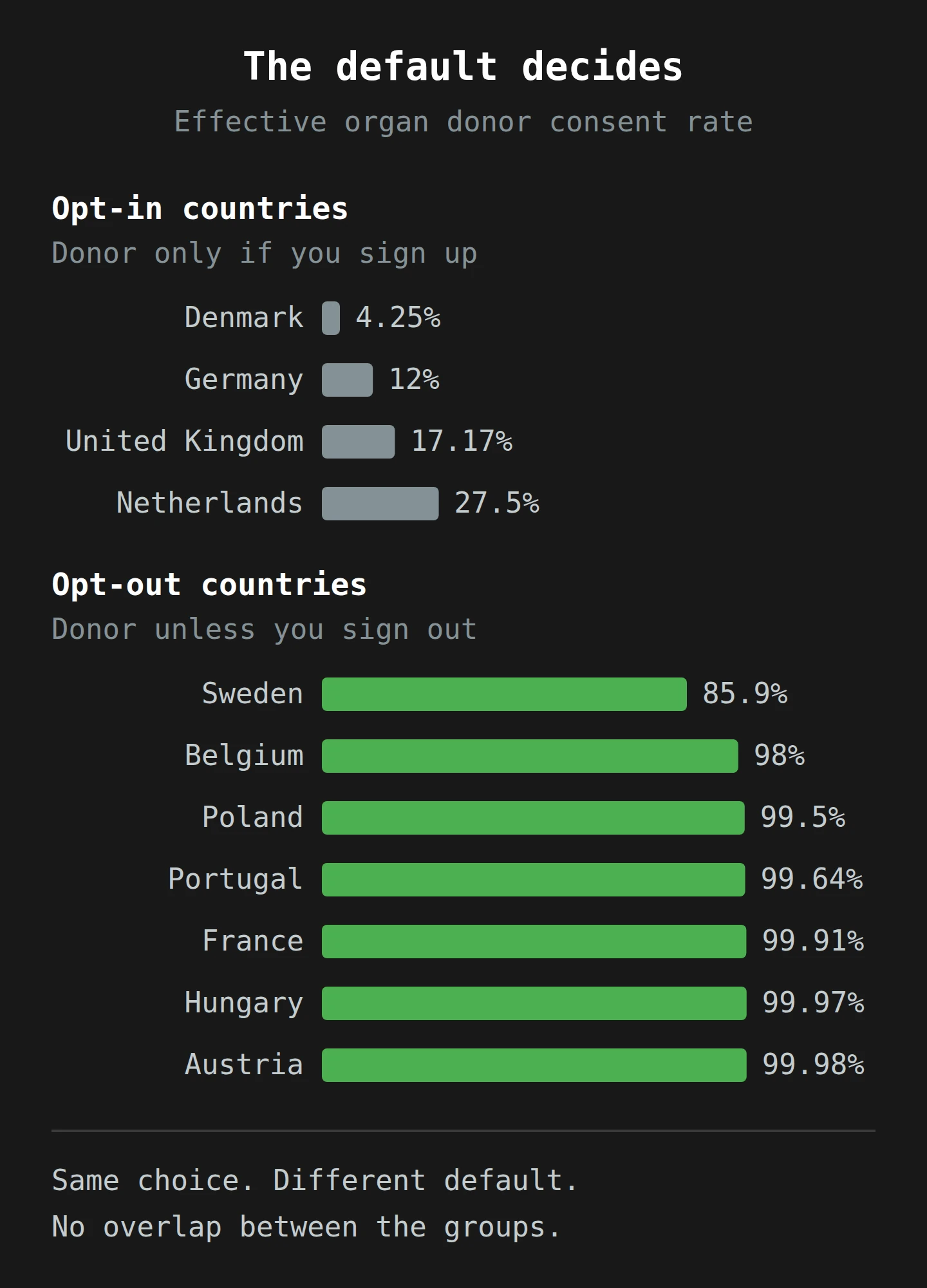
Austria and Germany share a border, a language and a great deal of culture. Their donor registers differ by a factor of about eight. The difference is the default.
Why the default wins
Johnson and Goldstein give three reasons, and each one maps onto a settings page with no effort at all.
- A default looks like a recommendation. People may believe that a default is the option the policy maker suggests. If LinkedIn set the switch to On, LinkedIn presumably thinks On is sensible.
- Changing it takes effort. Accepting the default is free. Changing it means finding the page, reading it and deciding. Every step loses people.
- The default is the status quo. Changing it feels like giving something up, and "losses loom larger than the equivalent gains". If the AI features are useful, switching off feels like a small loss.
The paper also notes that the same effect has been found in studies of how people choose Internet privacy policies. None of this is new to anyone who designs a sign-up form. I covered the honest version of this design problem in an earlier post on consent management.
The opt-out nobody saw
The organ donor research assumes that people at least know the question exists. LinkedIn's case adds a fourth reason that the 2003 paper did not need: most members did not know there was a switch. It was not in a notice they read. Members found it themselves, and word spread through social media and the tech press.
Australians are not famous for reading the paperwork, either. The OAIC's 2023 community attitudes survey found that only 21% of Australians always or often read privacy policies before providing their information. The same survey found that 84% want more control and choice over how their information is collected and used. People want the choice. They do not go looking for it.
LinkedIn has not published how many members switched off, and I will not guess. A settings page is not an organ donor register. But every force in the Johnson and Goldstein paper points the same way, and the extra one (nobody knowing the page was there) points that way harder.
If you opened LinkedIn in another tab while reading this section, welcome back. That tab is the default effect losing, one reader at a time.
An opt-out that most people never see works, in practice, like no choice at all. The outcome is decided by whoever set the default.
Part 4: Why "Going Forward" Does So Much Work

Defaults matter more for this setting than most, because of that sentence from the FAQ: opting out stops training "going forward, but does not affect training that has already taken place." You unsubscribe and the emails stop; you delete a photo and it leaves the page. AI training is different, and the reason is in how a model learns.
The song you cannot unhear
You hear a catchy song on the radio twice on the way to work. By lunch it is stuck in your head. You did not save a copy. You could not hand the song back if someone asked. It is in how your brain now works: what note you expect next, which word rhymes with which.
Take the song away tomorrow and you still know how it goes.
What training does to a post
A language model learns in a similar way, at a vast scale. It does not keep a library of the posts it read. Training adjusts a huge set of numbers inside the model, called parameters or weights, so that it gets better at predicting the next word in text like the text it saw. (I went through how this works in my post on GPT-3.) Each post nudges millions of those numbers by a tiny amount. After training, your post is not in the model as a file. Its influence is spread through the weights, mixed with everything else.
That is why "going forward" is honest. LinkedIn can stop putting your posts into future training runs. It cannot easily reach into a trained model and pull out the nudges your posts made, any more than you can hand back the song.
"Not word for word", mostly
In the intro I said the model is unlikely to quote your post back word for word. Here is the catch. Spreading influence through the weights does not always mean the original is lost. Sometimes a model memorises parts of its training data and can repeat them.
In 2020, a team led by Nicholas Carlini showed that they could extract hundreds of verbatim sequences from GPT-2's training data just by querying the model. The extracted text included "(public) personally identifiable information (names, phone numbers, and email addresses)". Some of it appeared in only one document in the training data. And, in their words, "larger models are more vulnerable than smaller models."
A follow-up study in 2022 measured the effect more closely. Memorisation grew with three things: the size of the model, the number of times an example was duplicated in the training data, and the amount of text used to prompt it. A post that is shared, reposted and quoted is, by definition, duplicated.
None of this means LinkedIn's models will recite your post. LinkedIn says it uses "privacy enhancing technologies to redact or remove personal data" from training data, and I have no evidence that it does not. It means "unlikely" is a probability, not a promise, and it gets bigger for content that is repeated.
Why unlearning is hard
Could a company remove your data from a trained model, if it wanted to? This is a research field called machine unlearning, and it is young. When Google announced the first Machine Unlearning Challenge in June 2023, its researchers described the goal as removing "the influence of a specific subset of training examples" while keeping the model useful. The simple way to do that is to retrain the model from scratch without the data. But "retraining deep models can be computationally expensive", so that is often not practical. Everything cleverer is still being worked out.6
So the switch works like a sign on the kitchen door that says "no eggs". Useful for the next cake. No help for the one already baked.
That is why the default is the decision. For most settings, a default that you fix later costs you a few weeks of a thing you did not want. For AI training, a default that you fix later still leaves your data in every model trained before you found the switch.
Redaction protects names, not stories
One more point, and it matters for any organisation. LinkedIn's privacy tools aim at personal data: names, email addresses, phone numbers, the things that identify a person. That is good. But a lot of what professionals post is not personal data. It is information about work.
"A regional water utility ran 40% over budget on a pipeline under the river" names no person. A redaction tool looking for names and phone numbers has nothing to remove. Yet anyone in that industry, in that state, may know exactly which utility and which pipeline it was. Privacy tools protect people. They were never designed to protect a client's confidential information. That is your job, and it is the subject of the next part.
Part 5: Odette Posts a Case Study

Meet Odette. Odette is a senior engineer at a small consultancy in Burnie. (She is made up. So are her firm, her client and her project. Burnie is real, and has excellent views of Bass Strait.) She has just finished a hard project for a regional water client: a new pipeline under a river, delivered late and over budget, but delivered. She learned a great deal. She wants to share it. Here is her week, and what each system records.
Monday. The project closes. Odette's firm has a contract with the client that includes a standard confidentiality clause. Nobody at the firm has read it since it was signed. The firm has a social media policy, written in 2019, that says "be professional" and nothing else.
Tuesday. Odette opens LinkedIn's writing assistant and pastes in her project notes to help shape a draft. The notes include the client's name, the budget overrun (40%), and a frank paragraph about a contractor. The assistant gives her a tidy draft.
What LinkedIn records: her notes, as an input to a generative AI feature. The help page is clear that the training switch "does not control the use of your data during the use of a generative AI feature". The FAQ says the information you give and the content generated "will be stored by LinkedIn until you delete it." Odette does not know either of those things.
Wednesday. She edits the draft and posts it. She has removed the client's name and the contractor's name. She has kept "a regional water utility", "a pipeline under the river", "40% over budget" and a photo of the site office whiteboard. It is a good post. It gets a lot of likes, including from three people at the client.
What LinkedIn records: a public post, attached to a profile with Australia as the location. The training switch on her account is On, because she never touched it. The post is now eligible for training content-generating models. LinkedIn's redaction removes personal data. There is very little personal data left in the post. The story is all still there.
What her firm records: nothing. There is no record that the post exists, what it says or whether anyone checked it.
What the client records: one of its managers sends the link to a colleague with the message "is this us?"
Thursday. Odette reads about the setting in the news. She finds it (Settings, then Data Privacy, then Data for Generative AI Improvement) and switches it off. She feels better.
What changes: from now on, her posts are out of training for content-generating models. Anything already used stays used. Her Tuesday notes are still stored, and the switch never applied to them anyway.
Friday. The client's manager calls the firm's director. The call is polite, and includes the phrase "confidentiality clause". Odette takes the post down. Then the director asks the question that matters: "How many of our people have posted things like this?" Nobody knows.
Odette did nothing sneaky. LinkedIn did what its new policy said. The privacy tools did their job, on personal data. The failure was between the systems. The switch belongs to each member, so the firm could not see it or set it. As far as I can tell from LinkedIn's help pages, there is no switch an employer can flip for its staff. The firm's policy did not say what counts as client material. And nobody had told Odette that the writing assistant and the training switch are two separate things.
Every one of those gaps can be closed in a week.
What to Do This Week
None of this needs a lawyer to start, although you may want one to finish.
For yourself (about two minutes)
- Find the switch. On desktop: Settings, then Data Privacy, then "Data for Generative AI improvement", then switch off "Use my data for training content creation AI models". If you are in the EU, EEA, Switzerland or the UK, you will not see it, because LinkedIn says it is not training on your data.
- Decide about the other models. The switch covers only models that generate content. If you also object to your data training LinkedIn's other AI models, the FAQ points to the "LinkedIn Data Processing Objection Form".
- Treat the writing assistant as a separate thing. The switch does not cover what you type into AI features. Do not paste in anything you would not post.
- Delete old AI sessions you do not need. LinkedIn says it keeps what you put into these features "until you delete it", and its data access tool lets you review and delete it.
For your organisation (this week)
- Tell your staff, with the exact path. You cannot flip the switch for them. You can send a two-line message today that explains what it is and where it lives. Make it a recommendation, not an order; it is their account.
- Define client material in your social media policy. "Be professional" is not a rule. Try this: if someone in our industry could work out which client or project a post describes, it needs approval before it goes up. Names removed is not the same as unidentifiable.
- Read your confidentiality clauses. Check what your client contracts say about publicity, case studies and public posts. If the answer is "written consent", your staff need to know that.
- Set a rule for AI writing tools. Any tool that takes your text as input, not only LinkedIn's. Client notes do not go into them unless your agreement with the tool's provider, and with your client, allows it.
- Check the other platforms. If your staff post work on Facebook or Instagram, remember Meta's evidence to the Senate: in Australia, public posts are used, and there is no opt-out. Setting posts to private is the control that exists.
If you are the one with the data
- Do the paperwork before the switch. If your organisation plans to use customer or user data to train an AI model, update your privacy policy and give notice before you start, not on the day. If your own policy promises notice "before they become effective", keep the promise.
- Run the tests in writing. In Australia, write down why a properly informed person would reasonably expect the new use (APP 6). If you have customers in the UK or EU, document the three-part legitimate interests test, and be ready for a regulator to ask for it.
- Make objecting clear, simple and early. That is the ICO's own phrase. Put the setting where people will see it, tell them it exists, and have it working before the first training run.
Final Thoughts
Go back to that Wednesday. The best post of your life, a cup of tea, forty-one likes, and a switch on a page you had never opened, already set to On.
The switch was real, and switching it off works. But it works going forward, and only for the people who knew to look. That is the one takeaway from LinkedIn's September: with AI training, the default is the decision, because the people who never find the switch never decide, and the training that happens before they find it cannot easily be undone. Europe and the UK got a different deal because their law asks companies to justify the default before they set it. Here, for now, it is mostly up to us.
So, this week: switch it off if you want it off, send your team the path, and write one sentence into your social media policy about client material. If you build products that run on other people's data, put the paperwork before the switch.
Now, if you'll excuse me, my tea went cold while I wrote this. I am making a fresh one. That cup, at least, I opted into.
Notes
-
Tasmania does not start daylight saving until the first Sunday in October, so on 18 September Hobart was ten hours ahead of UTC. By the time most of the northern hemisphere woke up to the story, Tasmania had already had afternoon tea. ↩
-
The earliest Wayback capture of the FAQ that includes the opt-out text is from 10:41 UTC on 18 September 2024. The page itself says "Last updated: 7 days ago", which is relative to whenever the page was loaded, so it cannot fix a date. The May 2024 capture of the same page has no opt-out text, and the Wayback Machine has no capture between 21 May and 18 September, so I cannot say exactly when the setting first appeared. TechCrunch reported on 18 September that "the toggle isn't new"; what was new was that people noticed it. ↩
-
The Wayback Machine has a capture of Lawit's post at 20:37 UTC on 19 September without the UK, and one at 13:24 UTC on 20 September with it. Somewhere in those seventeen hours, a regulator's concern became an edit. ↩
-
Meta's Senate inquiry evidence also covered children. Claybaugh said accounts of people under 18 were not scraped, but when Senator Tony Sheldon asked whether public photos of his own children on his account would be, she acknowledged they would. ↩
-
In the Johnson and Goldstein study, the effective consent rate means the share of people who had opted in, in opt-in countries, or had not opted out, in opt-out countries. If you are Danish and reading this, I am not judging. You were simply asked the question the other way round. ↩
-
If the only reliable way to forget is to retrain, and retraining is expensive, no company will retrain a large model each time a member changes a setting. That is why "going forward" is the realistic promise, not an evasive one. ↩