The Em Dash Is Innocent: Punctuation Is Not Provenance
It is 11.40 pm, and the report is finished. Forty-two pages, and one recommendation you have defended in four separate meetings. You read the summary aloud one last time, fix a comma, and send it to the steering committee with the quiet pride of a person who has used "therefore" correctly.
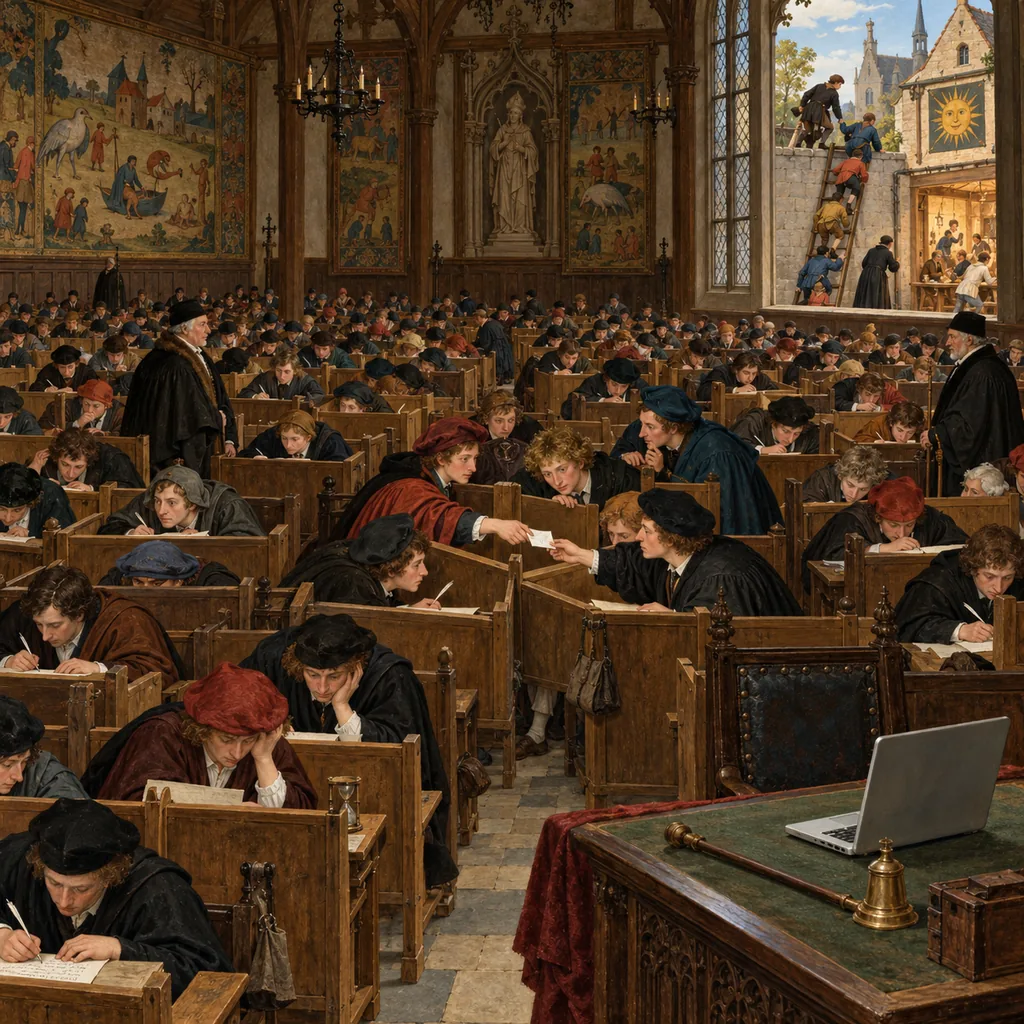
At 8.15 the next morning, Gareth replies all. Gareth is in Finance, and Gareth has a question. "Quick one," he writes. "Did ChatGPT write this?" Attached is a photo of page 12, taken on his phone at a slight angle, with a single em dash circled in red pen.
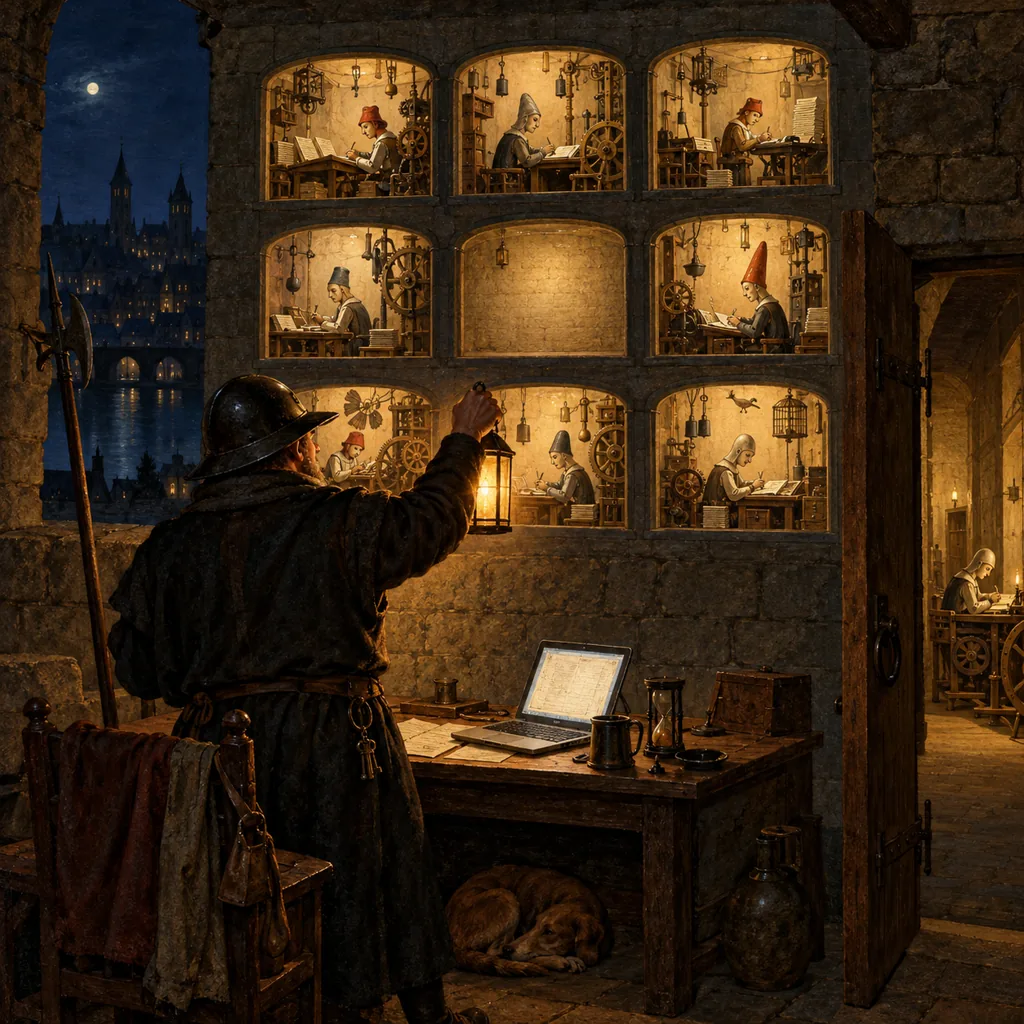
By 10 am, someone has printed page 12 at A3. By lunch, there is a working group. The dash is pinned to a corkboard, with red string running from it to a printed LinkedIn post and a sticky note that says "Ask IT?". The minutes, which are excellent, record that the dash was invited to speak in its own defence and declined, being a horizontal line about as wide as a capital H. The matter is adjourned until the dash can find representation.
Put the red pen down. You wrote that report, and the dash did nothing wrong. Gareth isn't a villain either. He has read the same posts as everyone else this year, and he has picked up a rule that sounds like expertise: long dash, therefore robot.
That rule is costing real writers real sentences. In April, the Washington Post spoke to Moniza Hossain, a children's author in Britain, who caught herself avoiding em dashes in a proposal for a new novel because she did not want an editor to think the pitch was AI-generated. "AI robbed the em dash from me," she said. In August, the AP Stylebook's editor wrote that the question of the day had become "If writing includes an em dash, does that mean it's written by artificial intelligence?" And four days ago, the chief executive of OpenAI announced that ChatGPT will now stop using em dashes, if you ask it nicely, in the right box. He called it a win.
Here is where I stand, so you can argue with me properly. I have used em dashes in formal report writing since 2012—in documents for exactly the kind of people who own red pens. I'm keeping them. Rejecting the em dash because a chatbot likes it judges the glyph, not the writing. It also takes a useful tool out of your kit for no gain, because the real tells of lazy machine text are somewhere else entirely.
So let's give the dash a proper trial. First, the charge sheet: how a punctuation mark became a suspect in 2025. Then the forensics: why language models really do reach for it, down to how a model picks its next token and what its tokeniser does with a dash. Then how to use one well, and an audit you can run on your own writing before your next report goes out. And last, what to look at instead when you really want to know if a machine wrote something.
Let's get into it.
Part 1: How a Punctuation Mark Became a Suspect
The charge sheet was written on social media, as charge sheets now are. In April, Rolling Stone's Miles Klee traced the case back to a LinkedIn post that read "I — keep — seeing — weird — long — dashes — in — posts", followed by a verdict: "Yes, this is the work of ChatGPT." On the ChatGPT subreddit, a user grew suspicious of a colleague's emails because "they use 'em dashes' a lot", and then added, with real honesty, "I didn't even know there was a shortcut for an em dash until looking this up."
The nickname got its big push from LuxeGen, a fashion podcast for Gen Z listeners. A host called the em dash "a 'ChatGPT hyphen'" while criticising a brand's advertising, and advised: "Public service announcement: Take out the hyphen."
It's a good nickname: catchy, and wrong in two of its three words. The mark is centuries older than ChatGPT, and it isn't a hyphen. (Part 3 sorts out the family. They are related, and they do not get along.)
The defence
The pushback came fast, and it came from people who write for a living. The same Washington Post piece collected it. Aileen Gallagher, a journalism professor at Syracuse University, said, "The idea that it is an indicator of soulless, dead AI-generated writing is really upsetting to me." J.T. Bushnell, of Oregon State University's School of Writing, Literature and Film, called the dash "aesthetically elegant": a mark that "captures something about natural inflections of speech in a way that other punctuation doesn't". Keep that line about speech in your pocket. It does real work in Part 2.
Even OpenAI sent the Post a statement, from Laurentia Romaniuk of its model behaviour team: "While we — and ChatGPT — have a soft spot for the em dash, our priority is making sure our models are helping users communicate their ideas clearly and effectively, in whatever style they choose."1
By August, the people who write the rules had joined in. Anna Jo Bratton, the AP Stylebook's editor, answered the question in one line: "Unfortunately, that tell is not the em dash, which has been around for many years." McSweeney's had already published a monologue by the dash itself, which protests the allegations at length and declares, "I am the punctuation mark of human frailty."
The prosecution has a point
Fairness matters here, because the people circling dashes are not imagining things. On 13 November, the Washington Post's data team published an analysis of 328,744 ChatGPT messages, all English GPT-4o replies of at least ten words, taken from publicly shared conversations between May 2024 and the end of July 2025. On the dash theory, its verdict is three words long: "They're onto something." A year earlier, fewer than one in ten ChatGPT responses used an em dash. Then, in the Post's words, "ChatGPT's em dash usage took off early this year."2
Wikipedia's editors, who keep a field guide for spotting machine-written text in the encyclopedia, put it neatly in that guide, Signs of AI writing: "While human editors and writers often like em dashes (—), AI loves them." Models use them, the guide says, "in a formulaic, pat way, often mimicking 'punched up' sales-like writing".
So the increase is real in the Post's sample of shared GPT-4o replies. That is evidence of a changing model habit, though the analysis does not compare those replies with a matched sample of human emails. That's the honest case for the prosecution, and I accept it.
Here is what it doesn't get you. The Wikipedia guide says so itself, in the next paragraph: "This sign is most useful when taken in combination with other indicators, not by itself." A habit that is more common in one population tells you very little about one document, because that document may come from the very large group of people who used the mark long before any chatbot did. I drink about 1,820 cups of tea a year. If you find a teacup on a desk, you have not found me. Gareth's red circle mistakes a fact about piles for a fact about page 12.
Four days ago
Then, on 14 November, this:
Small-but-happy win:
If you tell ChatGPT not to use em-dashes in your custom instructions, it finally does what it's supposed to do!
— Sam Altman (@sama), 14 November 2025 on X
TechCrunch's Sarah Perez filled in the details. The change works when you put the instruction in ChatGPT's custom instructions, and it "won't necessarily eliminate the em dash from its output by default". Before it, people had been unable to make the chatbot stop, "even when they specifically asked it not to". And she noted, correctly, that the dash had become a mark of shame "even if they weren't a reliable signal of content created by generative AI".
It's the word "finally" that interests me. The company that makes the model needed months, even after its chief executive promised a fix in July, to make it obey a one-line instruction about a single character. That tells you the habit runs deep. In July, Altman told the podcaster Theo Von, as Machine reported, where he thought it came from: "a lot of users like em-dashes, so we added more. And now I think we have too many em-dashes."
That is the best clue anyone has offered, and it came from the top. To see why it matters, we need to go inside the machine.
Part 2: Why the Machine Loves a Dash
We will take this in steps: how people use dashes, how a model chooses what to write next, what the model actually sees when it sees a dash, and then the suspects, sorted into evidence and guesswork.
Step 1: You already talk in dashes
Listen to anyone tell a story at a barbecue. "So I get to the ferry, and the bloke at the gate, Bruny Island born and bred, lovely fella, says…" Nobody says the commas out loud. What you hear is a voice that drops for an aside, pauses, and comes back up when the main line resumes. Sometimes it stops dead and changes direction.
Writing has to fake all that with marks on a page, and it has a small kit for the job. A comma is the lightest aside. Brackets are a quieter one, almost a whisper. The dash is the aside you want the reader to hear. That's what Bushnell meant when he said it "captures something about natural inflections of speech". Writing that wants to sound like a person talking—the chatty explainer, the friendly email—uses more of it.
Hold on to that, because "sound like a friendly person talking to you" is exactly what a chatbot is trained to do.
Step 2: The raffle drum
A large language model writes one token at a time. A token is a piece of text: often a word or part of a word, sometimes a single punctuation mark. I took the machinery apart in AI Hallucinations 101, and the short version is this. At each step, the model looks at all the text so far and gives a probability to every token in its vocabulary. One token is picked and added to the text. Then the whole thing runs again, for every token of every reply.
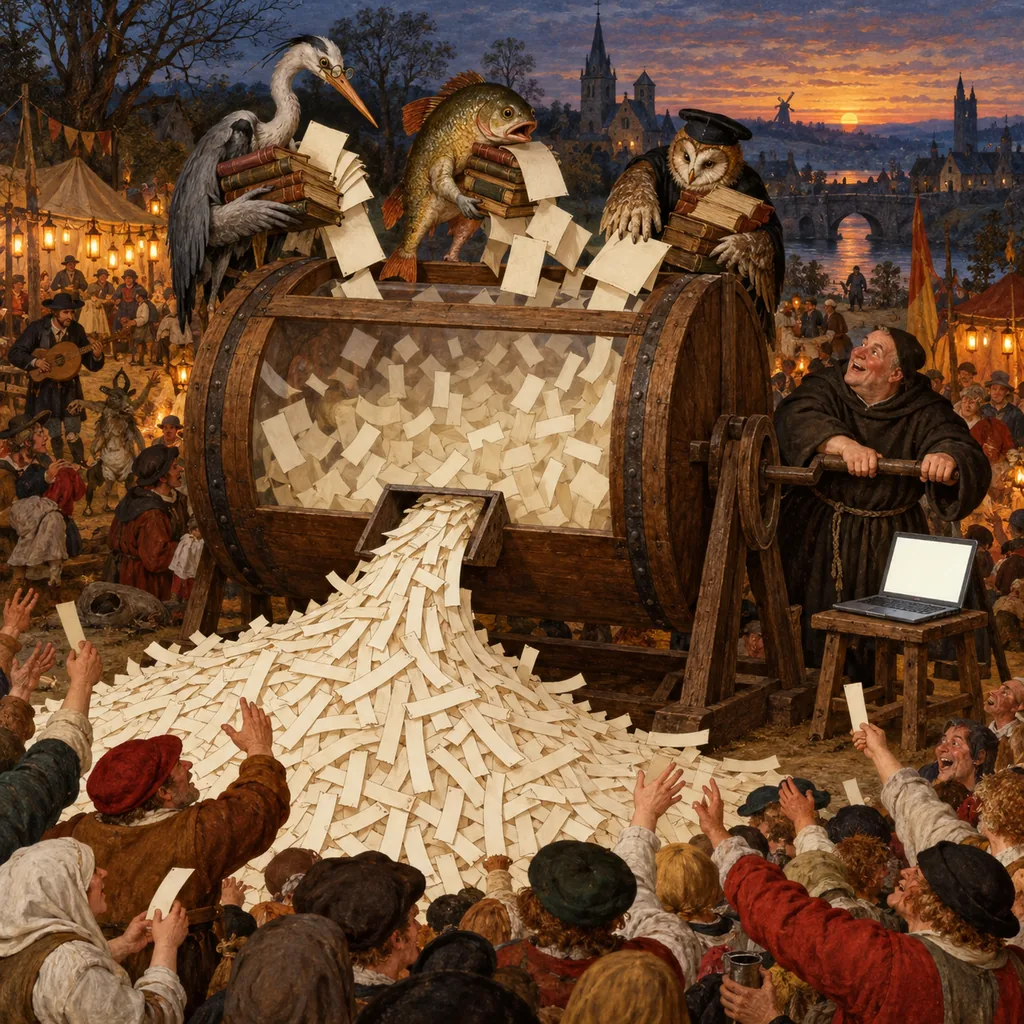
Picture a raffle drum at a country show. Before each token, the model fills the drum with tickets, one name per possible next token, and gives the likely ones more tickets. After "The kettle has", the ticket for " boiled" gets a thick stack. The ticket for " opinions" gets a few, because the internet is a strange place. Then a ticket is drawn. Chat products usually draw with the odds rather than always taking the biggest stack, which is why the same question can get different answers.
We are committed to the raffle now, so let's see what it does to punctuation. At almost every pause in a sentence, the dash is in the drum, competing with the comma, the colon, the full stop and the bracket. A slightly bigger stack of dash tickets would not change one sentence in a way you'd notice. But it gets a draw at nearly every pause in nearly every paragraph—and that small edge becomes a pattern across a page. A pattern is what Gareth spotted.
So the real question is who decides how many dash tickets go in the drum. Before we get to the suspects, there is one technical alibi to check.
Step 3: What the model sees when it sees a dash
A popular theory says the dash is special to the machine, a sort of cheap, flexible token that models find efficient. That is testable, so I tested it.
Tokenisers are built with byte pair encoding, which I walked through in Strawberry Has How Many Rs?. It starts from raw bytes, merges the most frequent pair it can find, again and again, and keeps each merge as a vocabulary entry. OpenAI publishes its tokenisers as an open-source library called tiktoken, and the library's list of models says which tokeniser each one uses: r50k_base for the original GPT-3 models, cl100k_base for GPT-3.5 and GPT-4, and o200k_base for GPT-4o. So I fed each of them some dashes.
In computer terms, an em dash is three bytes (E2 80 94 in UTF-8). In all three tokenisers, those three bytes have been merged into one token. The dash with a space in front of it is one token too. "word—word" comes out as three tokens in each tokeniser: word, —, word. A comma is also a single token. Replacing a comma with a dash can therefore leave the token count unchanged, though the surrounding text matters.3
The more interesting result is what the newer tokenisers glued onto the dash. In cl100k_base, 44 vocabulary entries contain an em dash, and in o200k_base there are 40, against 12 in the GPT-3 tokeniser. Among the new ones are whole pieces like —and, —the, —but and —it. A merge only happens when a pair turns up often in the text the tokeniser was built from, so those entries are consistent with recurring dashes followed by "and" and "but" in the tokeniser's training text. They do not tell us the source or age of that text, or how often a model will choose those tokens.4
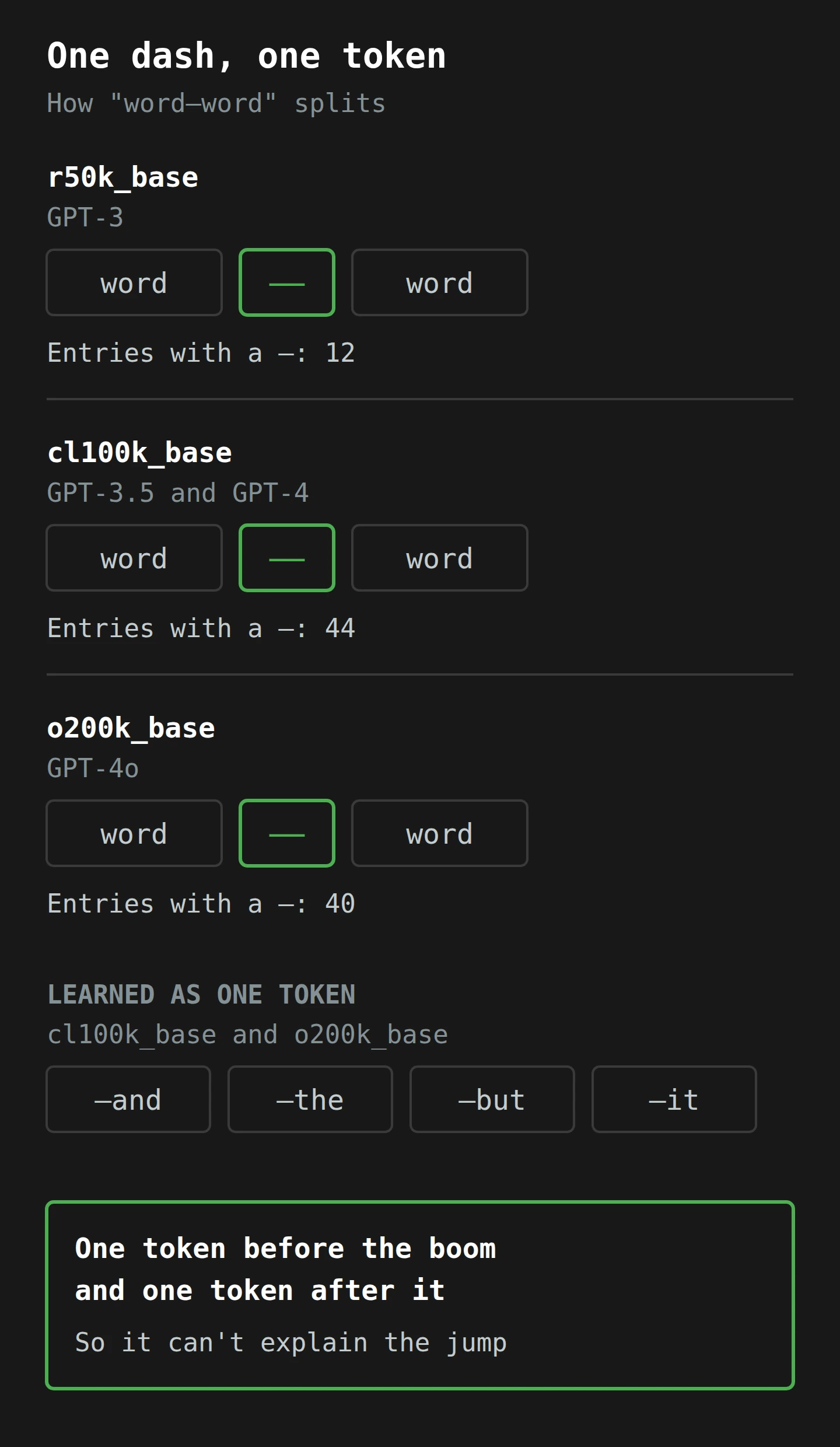
Now the limit of the tokeniser explanation. GPT-3.5 uses cl100k_base, where the dash was already a single, cheap token. (So does p50k_base, the tokeniser behind the GPT-3.5 completion model text-davinci-003. All four encodings tested here treat a standalone dash as one token.) Yet, by the account we will get to in a moment, GPT-3.5 hardly used dashes at all. GPT-4o uses a different tokeniser in which the dash is also one token, and it uses dashes heavily. The Washington Post's chart shows GPT-4o's own dash habit climbing in the first half of 2025, while the public GPT-4o encoding remained o200k_base. The tokeniser made the dash available before the boom. That availability alone does not explain why it became popular. This does not rule out an interaction between tokenisation and later training; it rules out the simple story that the dash suddenly became a cheap token. We still need to know who was stuffing the drum.
Step 4: The suspects
On 30 October, the engineer Sean Goedecke published the most careful explainer of the year, "Why do AI models use so many em-dashes?". He opens with an admission I respect: "we don't really know why language models use the em-dash so much". Then he works through the explanations one by one. Here they are, with my verdict on the evidence for each.
Suspect 1: A library of old books
Goedecke's starting observation, which he states without giving a method, is that "GPT-3.5 did not use them", that "GPT-4o used ~10x more em-dashes than its predecessor, and GPT-4.1 was even worse", and that Anthropic's and Google's models use them too. So what changed between 2022 and 2024?
His answer is the books. In his account, labs needed more high-quality text, which meant scanning print books, and court filings in the Anthropic copyright case showed that Anthropic started its scanning in February 2024. He assumes OpenAI did something similar. Old books are a different pile from the modern web. Goedecke quotes a large-scale corpus study of punctuation in English, which found that dash use "reached its peak (about 0.35%) in 1860" and has moved between 0.25% and 0.275% of words since the 1950s. If labs bought and scanned older books, he argues, the models learned from text with about 30% more dashes than contemporary prose.5 He also suggests a likely amplifier: newer models learn, at least in part, from text that older models wrote.
My verdict: plausible, and partly evidenced. The punctuation history is measured, and the book scanning is on the court record for one lab. The link between them is guesswork, because nobody outside OpenAI knows what went into GPT-4o's pile or how old its books were. Goedecke says this himself, plainly: "This is still largely based on speculation."
Suspect 2: The judges
The second suspect sits later in training. A raw model trained on the pile is not yet a polite assistant. Turning it into one involves people. OpenAI's 2022 InstructGPT paper describes the method directly: after showing the model good examples, the team would "collect a dataset of rankings of model outputs" from human labellers and then "further fine-tune this supervised model using reinforcement learning from human feedback". People rank answers, and the model is pushed toward the kind of answer that ranks well. I covered how that loop can go wrong in Sycophancy: When ChatGPT Became a Yes-Man. A model trained to win a vote learns whatever the voters like, including things nobody meant to reward.
In raffle terms, this is the show committee. It watches which tickets the crowd cheers for, and it quietly adds more of those tickets to the drum for next year.
The evidence that this happened with dashes is thin but pointed. Altman's July comment is a direct statement of it: users liked em dashes, "so we added more". OpenAI's own report on the April sycophancy rollback confirms that a GPT-4o update had "introduced an additional reward signal based on user feedback—thumbs-up and thumbs-down data from ChatGPT". And the Post's chart shows the dash habit rising in the first half of 2025, in a model that kept its name and was updated in place. Put those together, and my reading is that preference tuning amplified a habit the pile had already planted. That is my inference, not OpenAI's statement. The company has not said which signal moved the dash. Goedecke lands in a similar place: the theory that dashes "read more conversational" to the raters "could be right", but it is "Hard to say what evidence could confirm or deny it."
Bushnell's line from Step 1 explains why the crowd would cheer. If the dash is the mark that sounds like a voice, then a model rewarded for sounding warm and chatty has every reason to reach for it.
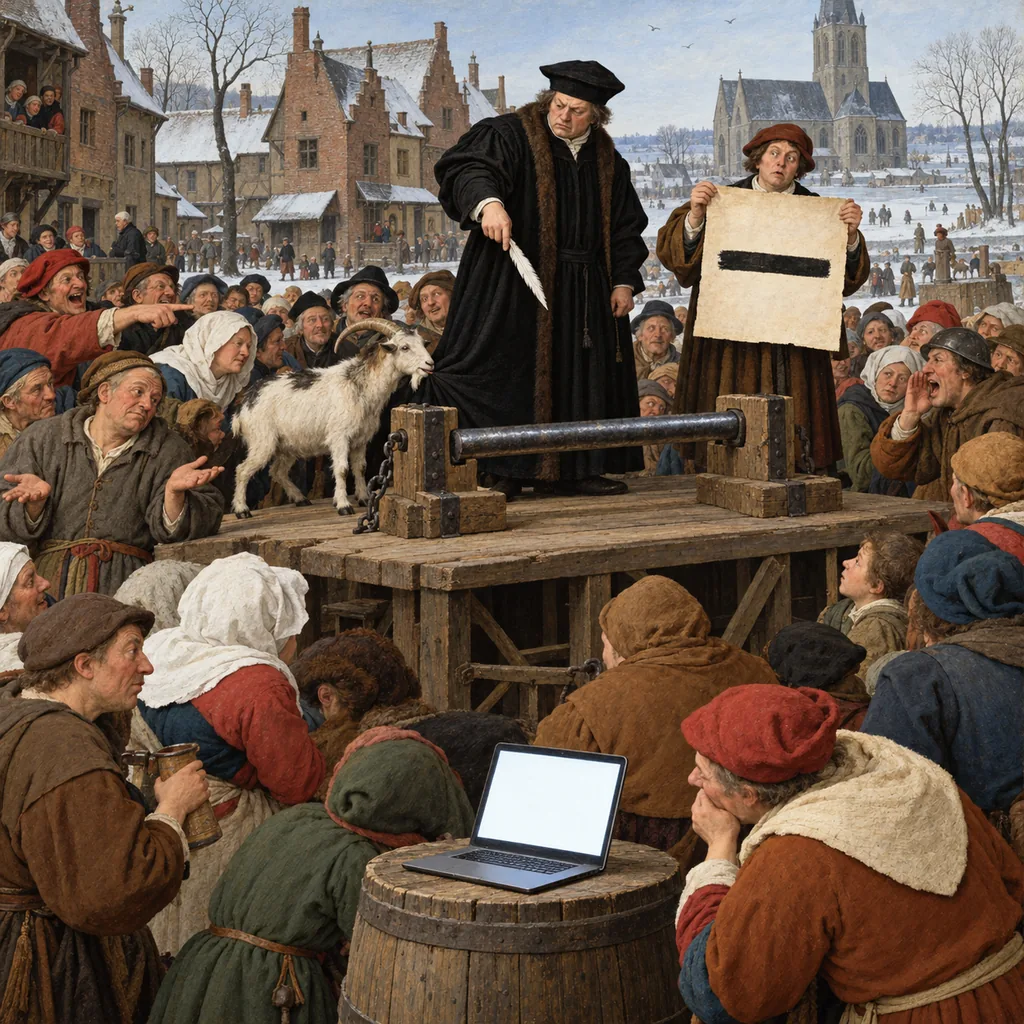
Suspect 3: The raters' English
The third theory has a history. In April 2024, Alex Hern at the Guardian offered an explanation for why ChatGPT loved the word "delve". The human feedback work is enormous, so the big AI companies outsource it to "parts of the global south, where anglophonic knowledge workers are cheap to hire", and "delve" is more common in business English in parts of Africa. So people asked whether the dash came from the same raters.
Goedecke tested it. He took a corpus of Nigerian English and counted: "0.022% of them were em-dashes", about a tenth of the general rate. That corpus had fewer dashes, not more; it does not directly measure the raters' own writing or preferences. His conclusion: "I don't think the overuse of em-dashes and 'delve' are caused by the same mechanism."
My verdict: this count weighs against the theory, though one corpus does not settle it for every dialect or rater. But Hern's closing worry belongs here anyway, because it is Gareth's mistake on a larger scale: "If AI-ese sounds like African English, then African English sounds like AI-ese." Judge writing by its surface habits, and sooner or later you are judging the people who share them.
Two alibis that hold
Two more theories don't survive. The first says a dash "keeps options open" for a model unsure what comes next. Goedecke points out that other marks are just as flexible, and he doubts that "playing it safe" is a useful way to think about how models generate text. The second says dashes save tokens. My test agrees with his: "the em-dash itself isn't inherently more efficient". And if a model wanted to save tokens, as he puts it, "it could simply waffle less".6
The scorecard
| Explanation | Status as of November 2025 |
|---|---|
| Tokenisation | Single-token availability is insufficient: the standalone dash was one token before and after the boom. Interactions with training are not ruled out. |
| Old print books in the training data | Plausible. The punctuation history is measured; the data mix is unknown. |
| Preference tuning (people liked it) | Likely amplifier. Altman's own words, and a documented feedback signal; no published data on dashes. |
| The raters' dialect | Not supported by Goedecke's Nigerian corpus count; raters' preferences were not tested. |
| Saving tokens, "keeping options open" | Not supported. |
Look at what the surviving explanations have in common. They trace the habit back to human writing and preferences. Old books and preference tuning are plausible contributors; their respective roles remain unproved. The machine didn't invent a robot punctuation mark. It overdid a human one. That is exactly why the mark tells you so little about who held the pen.
Part 3: How to Use One Properly
If we're keeping the dash, we owe it good handling. And the "ChatGPT hyphen" nickname is a useful place to start, because there are three marks in this family—and most keyboards only show you one.
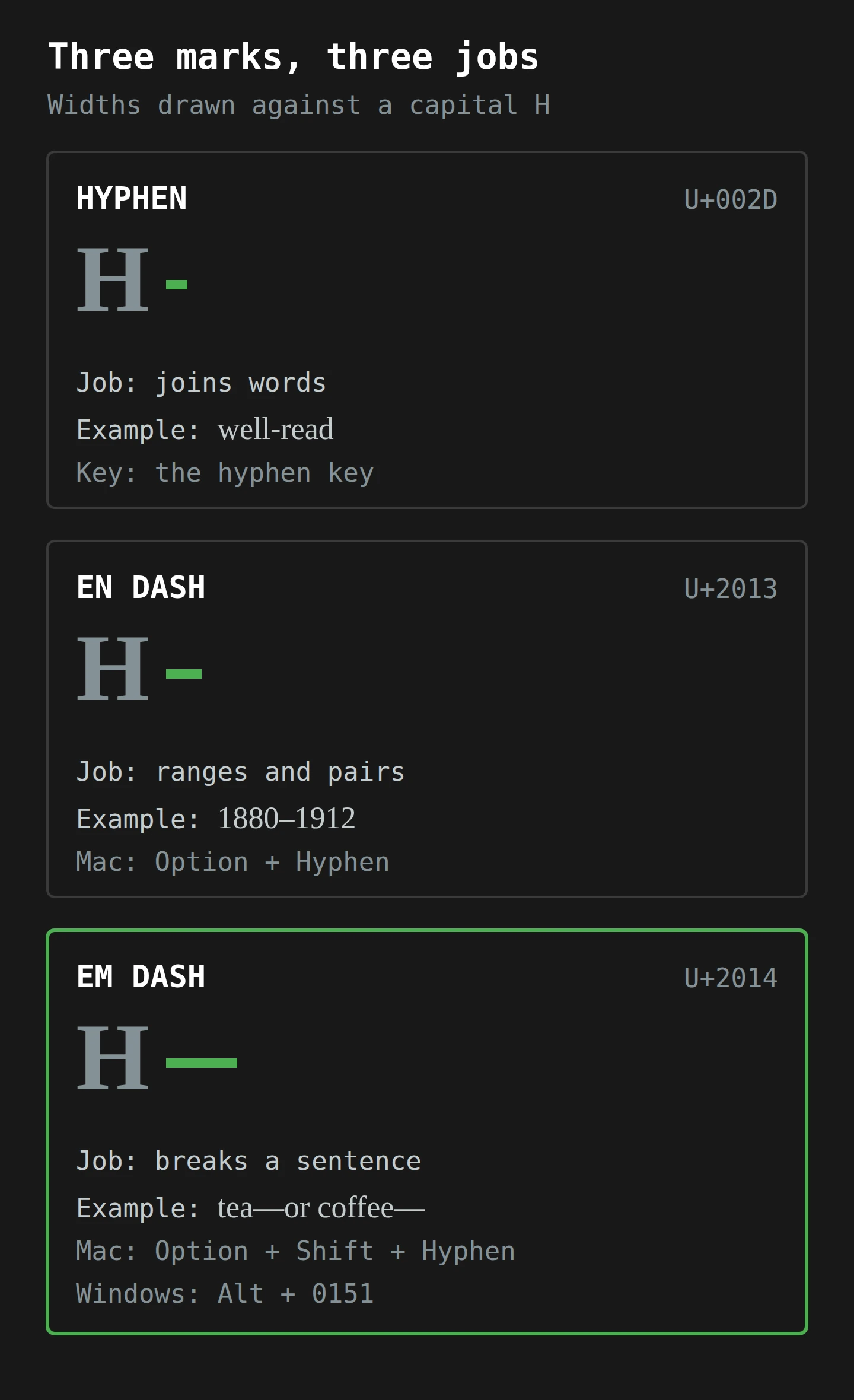
Hyphen, en dash, em dash
- Keyboard hyphen (-), U+002D (HYPHEN-MINUS). The short one, on your keyboard. It joins words: well-read, cost-effective, a five-dollar note.
- En dash (–), U+2013. The middle one, about half as wide as an em dash. Butterick's Practical Typography gives it two jobs: a range of values (1880–1912, pages 330–39) and a connection between pairs (the Sarbanes–Oxley Act). Australians know the second job from the Murray–Darling Basin, which is the Australian Government Style Manual's own example. It takes an en dash because two rivers meet there. A hyphen would make it one river with a double-barrelled name.
- Em dash (—), U+2014. The long one. Butterick says it is "typically about as wide as a capital H". It breaks a sentence.7
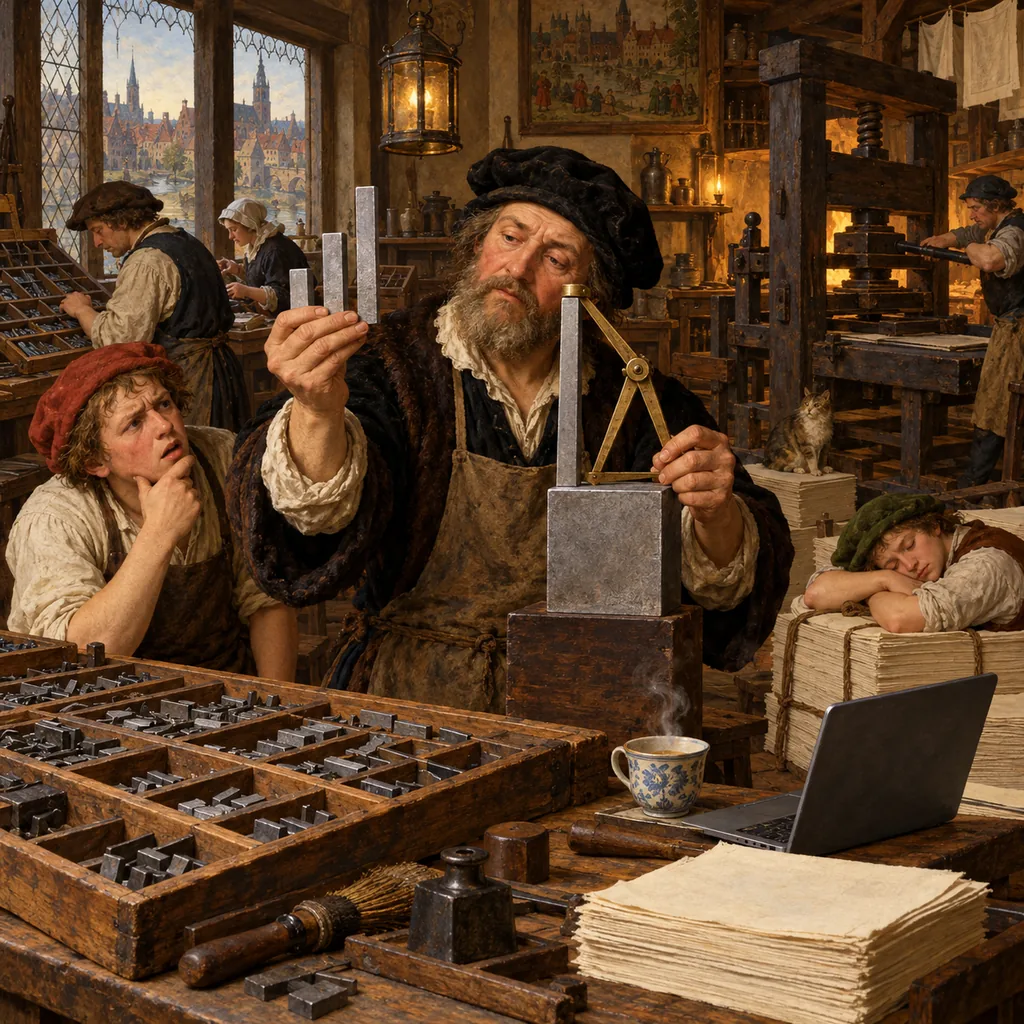
The names come from metal type. The em was a unit of measurement in the print shop, and the en was half of it.8
Two hyphens are not a dash. Butterick is blunt about the old habit of typing --: "Don't do that—it's another typewriter habit." Use the real mark. (How to type it is at the end of this part.)
The four jobs of an em dash
Butterick gives the cleanest test I know of: "Use it when a comma is too weak, but a colon, semicolon, or pair of parentheses is too strong." Inside that test, there are four jobs the dash does better than anything else.
1. A parenthetical pair. Two dashes around an aside you want the reader to notice. The Style Manual gives a test for a pair of dashes: take out the words between the dashes, and what's left must still be a complete sentence. "The report—all forty-two pages of it—went to the committee at 11.40 pm." Take out the middle, and you still have a sentence.
2. A break before a turn or a payoff. One dash, near the end, where the sentence changes direction or lands its point. The Style Manual describes this as "additional, amplifying and parenthetical material" and "an abrupt change". "Gareth found the dash and missed the argument" is fine. "Gareth found the dash—and missed the argument" makes the reader wait for the part that matters.
3. An aside that already has commas in it. When the inserted phrase is a list, commas around it turn the sentence into soup. The AP Stylebook's example: "He listed the qualities — intelligence, humor, conservatism, independence — that he liked in an executive." (AP spaces its dashes. We'll get to that fight shortly.)
4. Speech that breaks off. In dialogue, a dash shows a voice cut short. The Style Manual uses two em dashes in a row for this, with a space before them: "Any more questions before ——".
There's a fifth, minor job, which you have already seen in this article: the dash before a name at the end of a quotation, as under Altman's post. It is a convention, not a sentence job, and nobody has ever accused it of anything.
When another mark is better
The Chicago Manual of Style's Q&A makes the point that a dash "really can be used in place of just about any mark of punctuation". That flexibility is the trap. The same answer goes on: "Because dashes are so flexible, they tend to be overused. When in doubt, edit them out."
- A comma, when the aside is light and you don't want the reader to stop. "The report, which I finished last night, is attached." A dash there would be shouting across the office.
- A colon, when what follows explains or lists what came before. "There is one problem: the argument on page 12." A colon promises; a dash interrupts.
- Parentheses, when the aside is quieter than the sentence around it. Chicago again: "parentheses are not as abrupt as dashes, and they always come in pairs".
- A full stop, more often than you'd think. The AP's own advice is "Or you could just start a new sentence." If a sentence needs three dashes to hold together, it is two sentences.
Spaced or closed
There are two respectable ways to set a dash, and one bad way. AP style spaces the em dash. Its editor writes that dashes "always get a space on either side, except in sports agate", and in September the Stylebook's account said so again, after its blog post started a side argument:
Our recent blog post about the relationship (or not) between em dashes and AI generated a side conversation about how to format em dashes.
AP style calls for a space on both sides of a dash in all uses except the start of sports agate summaries.
We appreciate that AP style fans can passionately debate which dash to use and how to use it.
https://www.apstylebook.com/blog_posts/24
— APStylebook (@APStylebook), 18 September 2025 on X
Chicago closes it. CMOS Shop Talk puts both camps in two sentences: "In Chicago style, such dashes consist of em dashes—like this—with no space before or after. In British style, spaced en dashes – like this – are more common."
The Australian Government Style Manual took the British road for digital content: "Spaced en dashes are Australian government style and should be used in digital content." Its release notes explain the change. The sixth edition recommended a closed em dash; the digital edition moved to spaced en dashes partly so that "screen readers don't mistake an unspaced en for a hyphen". It allows another style reference if your publisher requires one, with a firm rule: "Follow one style: apply it throughout." And it is clear on the spacing of em dashes: "If you are using em dashes in your content, don't space them."
The bad way is to mix them. A spaced em dash on page 3, a closed one on page 7, an en dash on page 12 pretending to be either. The Style Manual's rule covers it: "Never use both types of dashes for the same purpose."
I write em dashes closed, as Chicago does and as the Style Manual's sixth edition did. It's the style I've used in formal reports for well over a decade, and it's the style of this article. If your organisation follows the current Style Manual, use spaced en dashes instead, every time. Either choice is fine. Mixing them isn't.
How to type one
None of these needs a data centre.
- macOS: Option + Shift + Hyphen for an em dash. Option + Hyphen for an en dash.
- Windows: hold Alt and type 0151 on the numeric keypad for an em dash (0150 for an en dash). In Word, Ctrl + Alt + the keypad minus key also works, and so does typing
2014and then pressing Alt + X. - Phones and tablets: on keyboards that offer it, hold down the hyphen key, then choose the longest option. The en dash is usually the second-longest.
- Word and Google Docs: by default, Word turns a double hyphen into an em dash. In Google Docs, two hyphens become an en dash and three become an em dash.
- HTML:
—for an em dash and–for an en dash.
All of these come from CMOS Shop Talk and Butterick, and the first three work on a bus to Glenorchy with no Wi-Fi at all.
Part 4: The Em Dash Audit
Here's the practical bit, in two halves. The first is for your own writing. The second is for the text that lands in your inbox.
Audit your own dashes
Open the last report you sent, and run these seven checks.
- Find them all. Search the document for "—". Then search for " - " and "--", which are hyphens doing a dash's job.
- Count per paragraph. One dash, or one pair, per paragraph is a good default. Two pairs is the ceiling. Past that, the dashes have stopped marking the important aside and started marking everything.
- Name the job. For each dash, say which of the four jobs it does: a pair, a turn, an aside with commas in it, or broken speech. If you can't name the job, it's a habit.
- Try the alternatives. Swap the dash for a comma, a colon, brackets or a full stop. If the sentence reads just as well, keep the swap. A dash should do something those marks can't.
- Read it aloud. A dash is a real pause in your voice, longer than a comma. If you don't pause there when you read it, your reader won't either.
- Look at the sentence around it. If the dash sits in "it's not X, it's Y", or in a sentence that only restates the one before it, the dash isn't your problem. The sentence is.
- Pick one style. Closed em dashes or spaced en dashes, chosen once and used everywhere. Search for the other style and fix it.
If you have been counting the dashes in this article, good. That is the audit, and you've been running it on me. There are 44 em dash characters in the article body, including quotations, examples, attribution lines, image descriptions and footnotes. That count includes the marks I am discussing, as well as the ones I use to shape a sentence.
What to check instead
Now for Gareth's real question: did a machine write this? The best evidence on how good people are at answering it comes from a 2025 study by Jenna Russell, Marzena Karpinska and Mohit Iyyer, People who frequently use ChatGPT for writing tasks are accurate and robust detectors of AI-generated text. They paid annotators to read 300 non-fiction articles, say whether each one was written by a person or by AI (GPT-4o, Claude 3.5 Sonnet or o1-Pro), and explain why. The annotators who use chatbots heavily in their own writing were remarkably good at it. A majority vote of five of them "misclassifies only 1 of 300 articles".
What they relied on is the useful part. "AI vocabulary" was the most common clue, in 53.1% of the explanations. Next came sentence structure (35.9%): predictable patterns, such as a "high frequency of 'not only . . . but also . . .'" or always listing three items. One annotator put it perfectly: "the comparison of 'it's not just this, it's this'". Then grammar (24.8%) and originality (23.7%), where AI text came across as "safe" and "lacking in surprises or humor".
And the dash? In the study's summary of the grammar clue, AI text "is usually grammatically perfect (also avoiding dashes and ellipses)". In one sample explanation for a human-written article, an annotator pointed to "a lot of variety in the article's grammar use, with dashes, brackets". Some readers in that study treated varied punctuation as a sign of a person. The study did not test whether an em dash alone could identify the author.
Now look at what was tested. The cited paper is the May 2025 revision; its GPT-4o experiment used the 2024-08-06 snapshot. The Post followed shared GPT-4o replies through July 2025. Those are different samples, so the two findings cannot establish that a particular update flipped the signal. But the Post's measured rise is enough to show why a fixed punctuation test needs caution. A changing model habit is a poor fingerprint for page 12.
So here is what to look at, roughly in order of how much it tells you:
- Does it say anything? Look for a specific claim you could check: a number, a name, a date, a source. Machine filler is fluent and empty. Rolling Stone's Klee described the real signature well: "the flat quality, the formulaic sentences, the absence of original ideas".
- The contrast reflex. "Not just X, but Y" and "it's not X, it's Y". The Post found versions of "not just X, but Y" in 6 per cent of ChatGPT chats in July. Wikipedia's guide calls these "negative parallelisms".
- Threes by default. Adjective, adjective, adjective. The guide says models "often use this structure to make superficial analyses appear more comprehensive".
- Summaries of what you just read. Paragraphs and sections that end by restating themselves. Wikipedia lists "In summary", "In conclusion" and "Overall" as words to watch.
- The vocabulary of the season. "Delve" was the word of 2023. In July 2025, according to the Post, it was "modern", in more than 8 per cent of messages. This list goes stale fastest, so treat it as a hint.
- Sources that don't exist. If the text cites anything, open two of the links. A made-up reference is the most serious problem on this list, whoever wrote it, and the easiest to check.
None of these is proof either. Wikipedia's advice applies to every one of them: combine signals, and never convict on one. Then ask the question that matters more than who typed it: is the text any good? A report that makes a specific, checkable, useful argument is worth reading whatever wrote it. A report that says nothing is worth nothing, with or without dashes.
One more thing, for anyone who uses ChatGPT and wants fewer dashes: Altman says the instruction now works, so put it in your custom instructions. But taking the dashes out of an empty paragraph gives you an empty paragraph with commas. Goedecke makes the same point about the most famous construction of the lot: the "it's not X - it's Y" pattern "could simply be replaced with a comma".
Final Thoughts
Back to Gareth, page 12 and the corkboard. The working group can stand down. The dash on page 12 was doing job number two: a turn before the point the whole report was making. Gareth's real question was never "Is there a dash?" It was "Is the argument on page 12 right?" He can answer that one, and he should, because it's the only question that changes the decision.
Here's the takeaway. Punctuation is not provenance. The em dash was in the books long before the machines read them. The machines learned it from human writing and overdid it, and the Post's evidence shows how much the habit has already shifted. Judge writing on whether it says something specific and true. Use the dash when a comma is too weak and a colon is too strong, and set it one way throughout.
Your next step is small. Open the last thing you wrote, search for the dash, and run the seven checks. Keep the dashes that do a job. And if anyone circles one in red, send them this article, then ask what they thought of your argument.
I have written em dashes since 2012, and I write them closed. I will still be writing them that way after the next model update decides it prefers semicolons.9 Now, if you'll excuse me, my tea is ready—and, for once, so is my point.
Notes
-
The spaces around the dashes in OpenAI's statement to the Washington Post are the Post's house style, which follows AP. Part 3 covers the spacing argument. It is a surprisingly heated one, for a gap of about a millimetre. ↩
-
The Washington Post discloses, in its November 2025 analysis of ChatGPT messages, that it has a content partnership with OpenAI. The messages were publicly shared conversations preserved by the Internet Archive, so they are a sample of what people chose to share, not of all ChatGPT use. ↩
-
In the two newer tokenisers, a dash can save exactly one token in some sentences: "X—it" is two tokens, because
—itis a single entry, while "X, it" is three. That context-specific saving does not establish why a model changed its style; GPT-3.5's cl100k_base already had those entries. ↩ -
A tokeniser is trained on its own sample of text, which is not necessarily the same as the model's full training data. So read these merges as a hint about the kind of writing OpenAI collected, not as a measurement of it. ↩
-
Goedecke's favourite book, Moby-Dick, has by his count "a staggering 1728 em-dashes!" He then asks the fair follow-up question himself: "why doesn't AI prose read more like Moby-Dick?" Nobody has a good answer yet, and the whales are not commenting. ↩
-
Goedecke also records a theory that the blogging platform Medium caused the trend, because Medium converts two typed hyphens into an em dash and was a source of good training text. He rejects it: "This just isn't plausible to me at all." His wider point is that a theory like this could explain the character turning up, but not the way models use it. ↩
-
The Style Manual adds a related trap for anyone writing numbers: don't use an en dash as a minus sign, because "Screen readers will read dashes as dashes, not as the minus symbol." The real minus sign is U+2212, or
−in HTML. ↩ -
Butterick says loud print shops called the em and the en "mutton and nut", so that nobody would mix them up across a noisy room. I would like this rule extended to all meetings where two people have similar names. ↩
-
This is less of a joke than it sounds. Goedecke thinks GPT-5's "overuse of semicolons probably is a brevity bias", because GPT-5 is less wordy than earlier models. The next suspect is already in the drum. ↩